
আরও দেখুন


 13.03.2026 08:24 PM
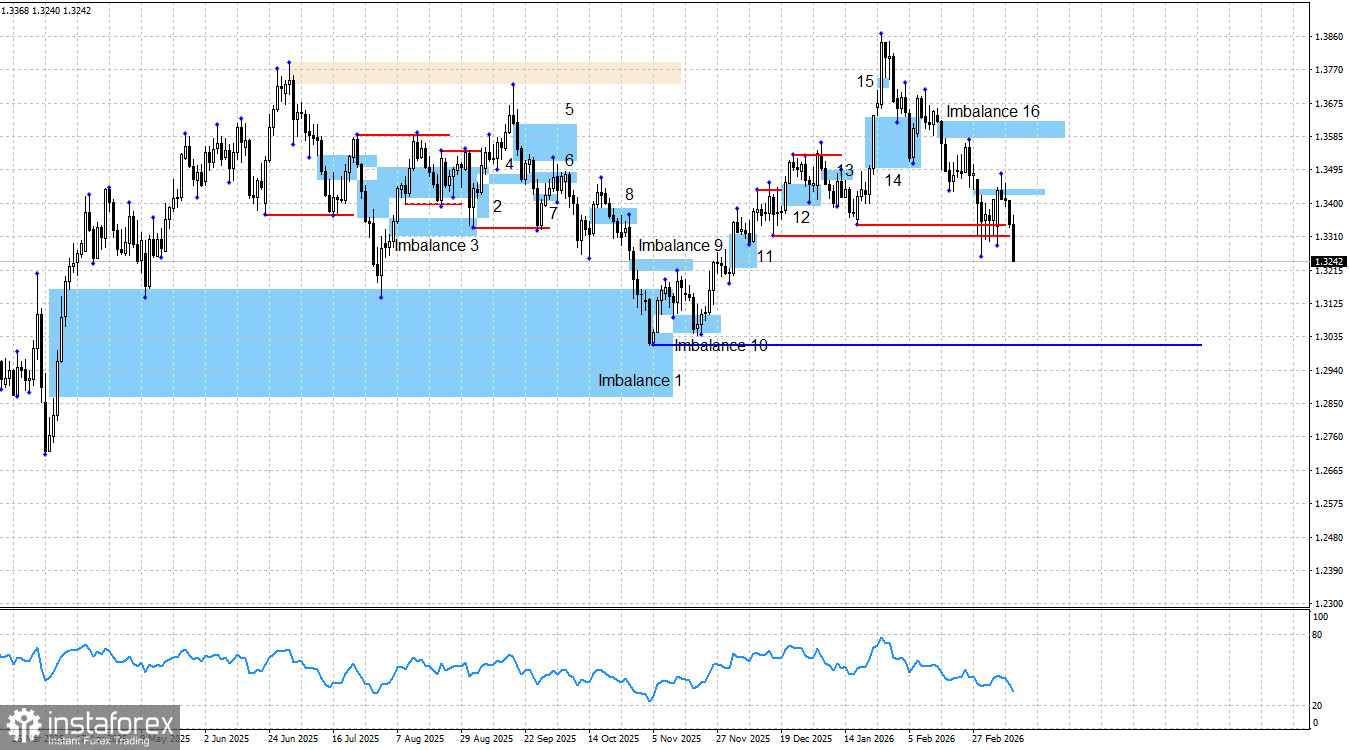
The GBP/USD pair reversed after five attempts to consolidate below the last two bearish swings, but the growth that followed this warning signal turned out to be short-lived. I previously highlighted a bearish imbalance on the chart, which was and still is clearly weak. However, it was precisely this imbalance that sent the pound into another free fall. Most likely, a much more significant role in the new decline of the GBP/USD pair was played by a clearer sell signal on the euro. However, for traders this makes little difference. The U.S. dollar is rising again—driven solely by geopolitics—and when the situation in the Middle East will stabilize is something no one can predict with more than 50% certainty.
There was no open escalation of the conflict in the Middle East this week, but Iran has effectively begun implementing the most severe scenario of confrontation with the United States and Israel. Many traders probably expected a repeat of last summer's scenario, when the U.S. struck Iran's nuclear facilities, Iran responded with strikes on American military bases, and the conflict faded afterward. However, March 2026 shows that the scenario may be very different this time. The Strait of Hormuz will remain blocked until... what exactly? What would have to happen for Iran to lift the blockade? It is extremely difficult to answer this question.
At the moment, there are no bullish patterns, but the price has reacted to a small imbalance which, together with a stronger sell signal on the euro and ongoing geopolitical tensions, once again allowed bears to push forward. Under the current circumstances, the pound may continue falling toward the 1.3000–1.3100 level, below which the bullish trend would be completely broken.
However, the bullish trend in the pound still remains intact. As long as it holds (above the 1.3012 level), I would pay more attention to bullish signals. Yet at present there are no bullish patterns or signals, and geopolitics continues to weigh heavily on both the euro and the pound.
The news background on Friday worked against both the British pound and the U.S. dollar. However, I have no doubt that neither the British reports nor the American ones had any real influence on trader sentiment. The pair's decline began in the morning—which could still be linked to UK statistics—but during the second half of the day, the most important reports from the U.S. should have led to a decline in the American currency.
In the United States, the overall information backdrop remains such that, in the long term, nothing but a decline of the dollar should be expected. The war between Iran and the United States changes little in this regard. The situation for the dollar remains difficult in the long term but positive in the short term. U.S. labor market statistics continue to disappoint more often than they please. Three of the last four meetings of the Federal Open Market Committee ended with dovish decisions.
Military actions by Donald Trump, threats toward Denmark, Mexico, Cuba, Colombia, EU countries, Canada, and South Korea, the initiation of a criminal case against Jerome Powell, government shutdowns, the scandal involving the U.S. elite connected to the Jeffrey Epstein case, a possible impeachment of Trump by the end of the year, and the highly likely defeat of Republicans in upcoming elections all complement the current picture of a political and structural crisis in America.
In my opinion, bulls have everything they need to resume their advance during 2026, but at the moment traders are ignoring everything except geopolitics.
A bearish trend for the pound would require a strong and stable positive information background for the dollar, which is difficult to expect under Donald Trump and unlikely to be provided by geopolitics. Therefore, I still do not believe in a long-term bearish trend for the pound. Too many risk factors continue to weigh on the dollar. Bearish patterns may be used to consider opening sell positions, but the current decline of the pound is driven by only one factor, while all others are being ignored.
Economic Calendar for the United States and the United Kingdom
United States
On March 16, the economic calendar contains only one entry, and there is little hope that the market will pay attention to it. The influence of the news background on market sentiment on Monday may again be extremely weak or nonexistent.
GBP/USD Forecast and Trader Advice
For the pound, the long-term picture remains bullish. There are currently no active bullish patterns; only a bearish imbalance is present, to which the price must first return and react before traders can consider opening potential sell positions.
It should also be noted that the sharp decline of the pound in recent weeks occurred due to an unfortunate combination of circumstances. If Donald Trump had not repeatedly threatened to attack Iran, had not sent warships to the Persian Gulf, and had not ultimately started a war, we likely would not have seen such a strong rise in the dollar.
I believe this decline may end just as unexpectedly as it began. However, for now it continues, and the price has already reacted to the latest bearish imbalance. Given the current unstable information environment, I would not attempt to forecast the pound's decline toward specific levels.


