
আরও দেখুন


 06.04.2026 01:46 PM
See also: InstaTrade trading indicators for NZD/USD
The NZD/USD pair begins the new week with cautious optimism, trading around 0.5710–0.5720 ahead of the US session open on Monday, after bouncing from four-month lows near 0.5680, following reports of possible progress in talks on a ceasefire between the US and Iran. However, this gain remains fragile amid ongoing geopolitical uncertainty and rising expectations of tighter policy from major central banks.
Current situation: fundamental pressure persists, while temporary breather in doubt
On Monday, reports emerged that the US, Iran, and regional mediators are discussing terms for a potential 45-day ceasefire that could end hostilities. This news briefly weakened the US dollar as a safe haven asset, which supported the kiwi and other risk-sensitive currencies.
However, optimism is restrained. US President Donald Trump set a deadline for Iran on Tuesday, demanding the reopening of the Strait of Hormuz, and threatened otherwise to strike power plants and bridges in the country. Iran, for its part, replied that it is ready to strike US infrastructure in response and presented new conditions: transit through the strategic waterway could resume if part of the transit revenues is allocated to compensate for war damage. Chances of reaching an agreement within the next 48 hours remain low.
Beyond geopolitics, the pair is pressured by expectations that global central banks, including the Fed, will be forced into a more hawkish stance due to war-driven inflation. Investors are already pricing in a Fed rate increase in 2026, which is a strong headwind for NZD/USD.
On Friday, a strong US labor market report was published: the economy added 178,000 jobs in March, well above forecasts, and the unemployment rate fell to 4.3%.
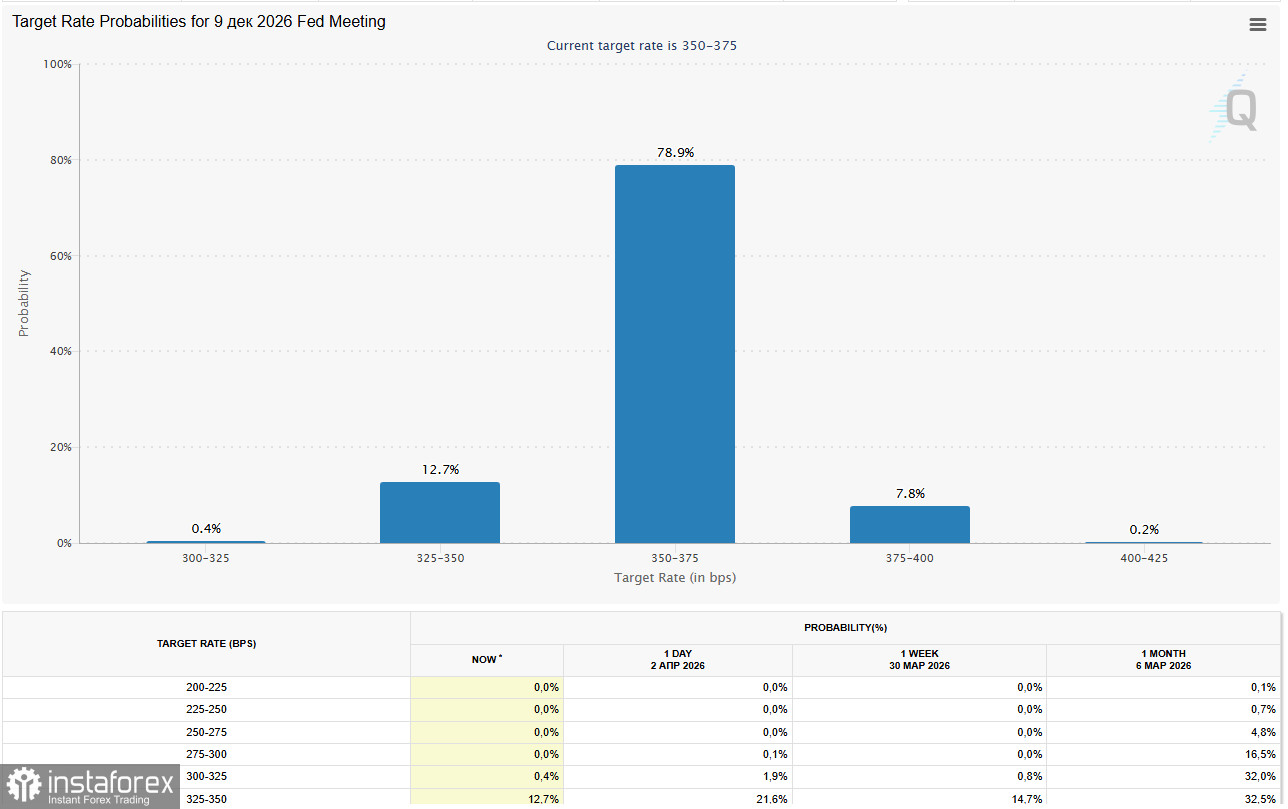
According to the CME FedWatch tool, the probability that the Fed will keep rates unchanged through the end of the year is 78.9%.
RBNZ factor: dovish pause
A central event for NZD this week will be the Reserve Bank of New Zealand (RBNZ) meeting on Wednesday. Markets unanimously expect the regulator to keep the official cash rate, OCR, at 2.25%.
RBNZ Governor Anna Breman previously indicated that the bank may "look through" temporary inflationary pressure driven by higher energy prices but would be ready to raise rates if long-term inflation expectations are threatened. Economists believe the central bank could signal future hikes if energy inflation proves persistent.
Markets price in nearly a 40% probability of a rate increase by September 2026, and a full 25-basis-point hike is fully priced in by December.
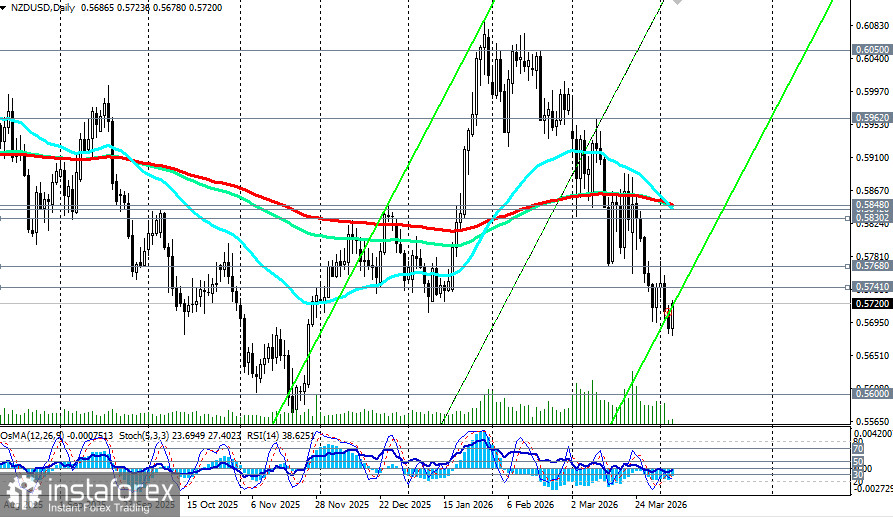
Brief technical analysis
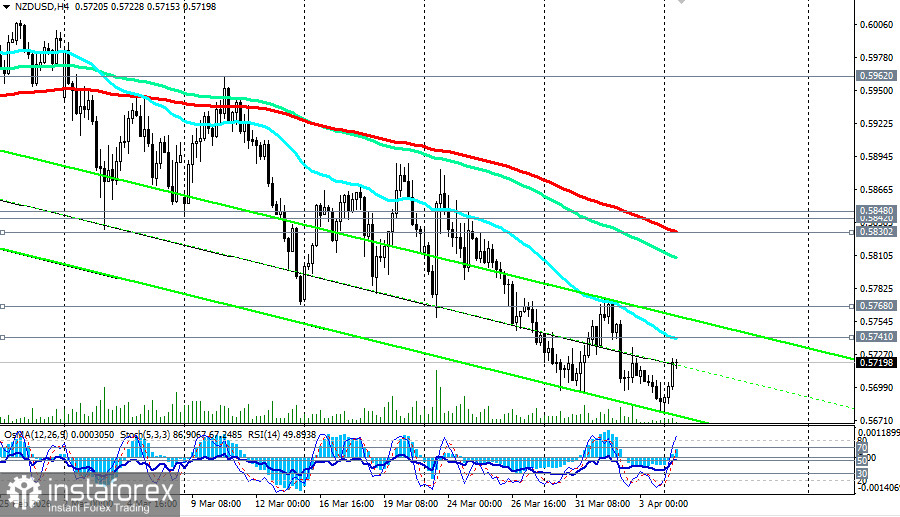
On the 4-hour chart, NZD/USD shows early signs of a potential reversal. Price bounced from the lower boundary of the downtrend channel, in which the pair has traded since late January, losing more than 6% over that period.
The RSI indicator displays a bullish divergence, slowly rising toward the key 50 level, while the OsMA has crossed its signal line from below, and the stochastic touched overbought territory.
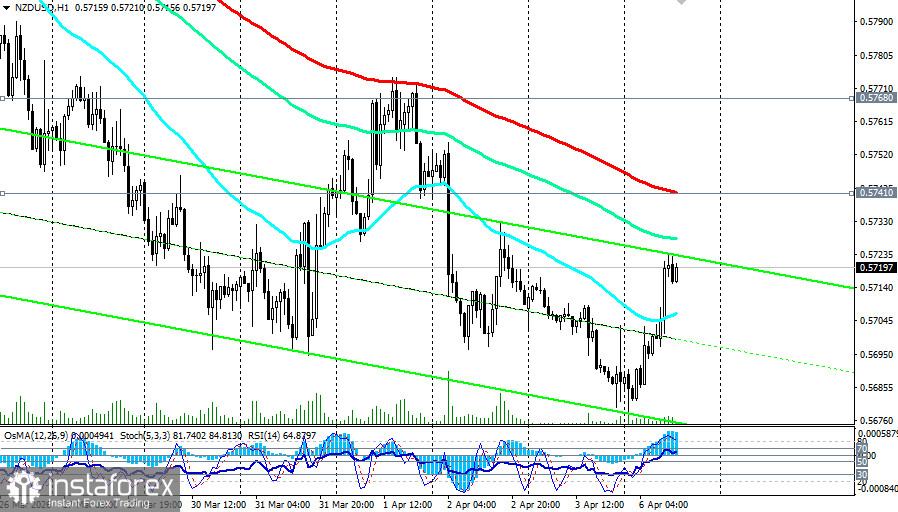
Meanwhile, on the 1-hour chart, all three indicators (RSI, OsMA, and stochastic) moved in favor of buyers during the Asian session.
Scenario A (base): continued pressure
The most likely scenario is that the pair remains under pressure, testing support at 0.5660–0.5680 in the coming days. Triggers for this scenario may include:
- failure of ceasefire talks and escalation after Trump's ultimatum,
- hawkish signals from the Fed and a persistently strong dollar,
- cautious RBNZ rhetoric without hints of future tightening.
Scenario B (bullish): sustained recovery
Possible if there is real progress in talks and easing of geopolitical tensions. In that case NZD/USD could settle above 0.5740 and move toward 0.5780–0.5800.
Key events this week
- Tuesday: Trump's deadline for Iran — key geopolitical trigger,
- Wednesday: RBNZ meeting (OCR) — OCR expected to remain at 2.25%,
- Wednesday: publication of the Fed minutes (FOMC) — signals on the rate path,
- End of week: US PCE and CPI data — assessment of inflationary pressure.
Conclusion
NZD/USD is at a critical juncture. The short-term rebound on hopes for a ceasefire gives the kiwi a temporary breather, but fundamental risks — a strong dollar, expectations of Fed tightening, and persistent geopolitical uncertainty — remain in force.
The key zone 0.5680–0.5740 will be the arena of the decisive battle in the coming days. Holding above 0.5680 will preserve chances for a recovery to 0.5740 and higher, but a break below will open the way to 0.5660 and 0.5580.
See also: NZD/USD — scenarios of movement on 06.04.2026
Under any scenario, volatility will remain high. Investors should closely monitor developments around Trump's Tuesday ultimatum, the RBNZ meeting on Wednesday, and, most importantly, the Fed minutes, which may provide key signals on future US interest rate policy. Success will favor those who can separate short-term ceasefire hopes from longer-term macroeconomic realities.


