
আরও দেখুন


 08.07.2026 04:24 AM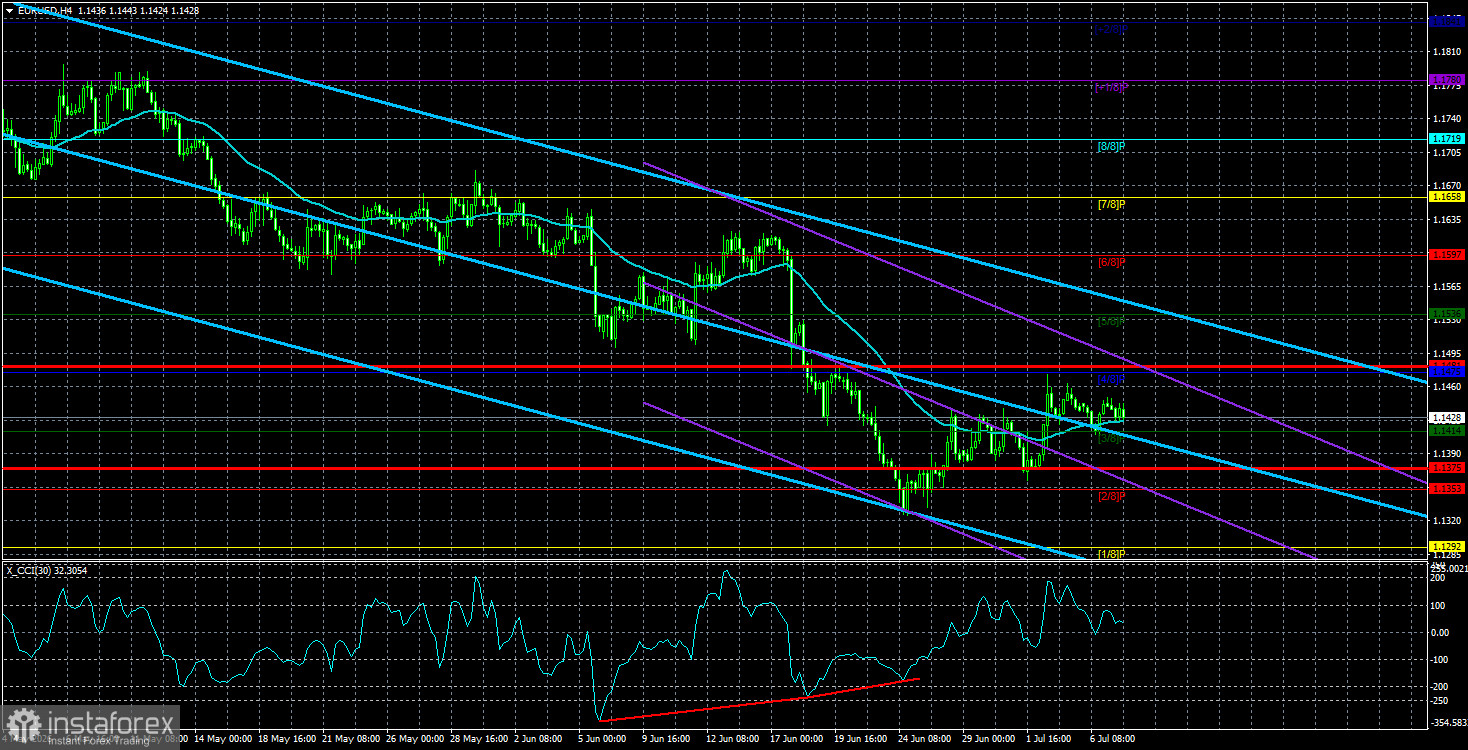
The EUR/USD currency pair traded in an ultra-calm manner on Tuesday, as we had warned. There are currently no news or events that could provoke strong market movements. Geopolitics has faded into the background, even though the market has not considered the end of active hostilities in the Middle East. The Federal Reserve's monetary tightening has also been priced in. The European Central Bank's rate hike has been ignored, and the Nonfarm Payrolls report has been absorbed. This week, only the ISM Services PMI could have triggered a market reaction, but its results aligned perfectly with forecasts. Therefore, there are currently no grounds for high volatility.
Meanwhile, news from the Middle East continues to flow. Recently, it was revealed that the U.S. and Iran have halted negotiations for a week due to the funeral of Iran's Supreme Ayatollah Ali Khamenei following missile strikes by the U.S. The next round of negotiations is scheduled for July 11. Additionally, Iran attacked two tankers in the Strait of Hormuz. "Our tale is good; start over." Tehran has once again breached the ceasefire terms, and both sides of the conflict have acknowledged it. This is primarily because no one wants to continue fighting, but Iran now intends to fully utilize the Strait of Hormuz.
In simple terms, the Strait of Hormuz is transforming from a tool for U.S. and global coercion into a means of generating revenue for the Iranian budget. Within 60 days of signing the memorandum of understanding, Tehran plans to impose fees on all vessels wishing to cross the strait. Since the strait is under the jurisdiction of not only Iran but also Oman, Tehran has already proposed to Muscat that they divide control over this strategic geographic area. Muscat is not eager to impose usage fees, as it does not want to harm its relationships with partners. Meanwhile, Iran, recognizing Oman's current disposition, demands that commercial ships pass through the strait only near Iranian territory. Vessels aiming to cross the dangerous area near Oman risk coming under fire.
As we can see, the situation in the Middle East is not changing—neither for the better nor for the worse. Traders are already tired of the geopolitical narrative. For them and the rest of the world, the main point is that the Strait of Hormuz is open and oil prices have fallen to pre-war levels. Thus, Iran, Oman, the U.S., and other Middle Eastern countries can divide the strait as they see fit. The key factor is that oil and gas prices remain low.
The euro remains in a weak upward correction against a two-month downward trend. Currently, we do not see any market desire to reverse the dollar's trend. Although there are no substantial reasons for the continued growth of the U.S. dollar, the market is in no hurry to sell it. There are no significant events scheduled for this week, so we may see movements with minimal volatility.
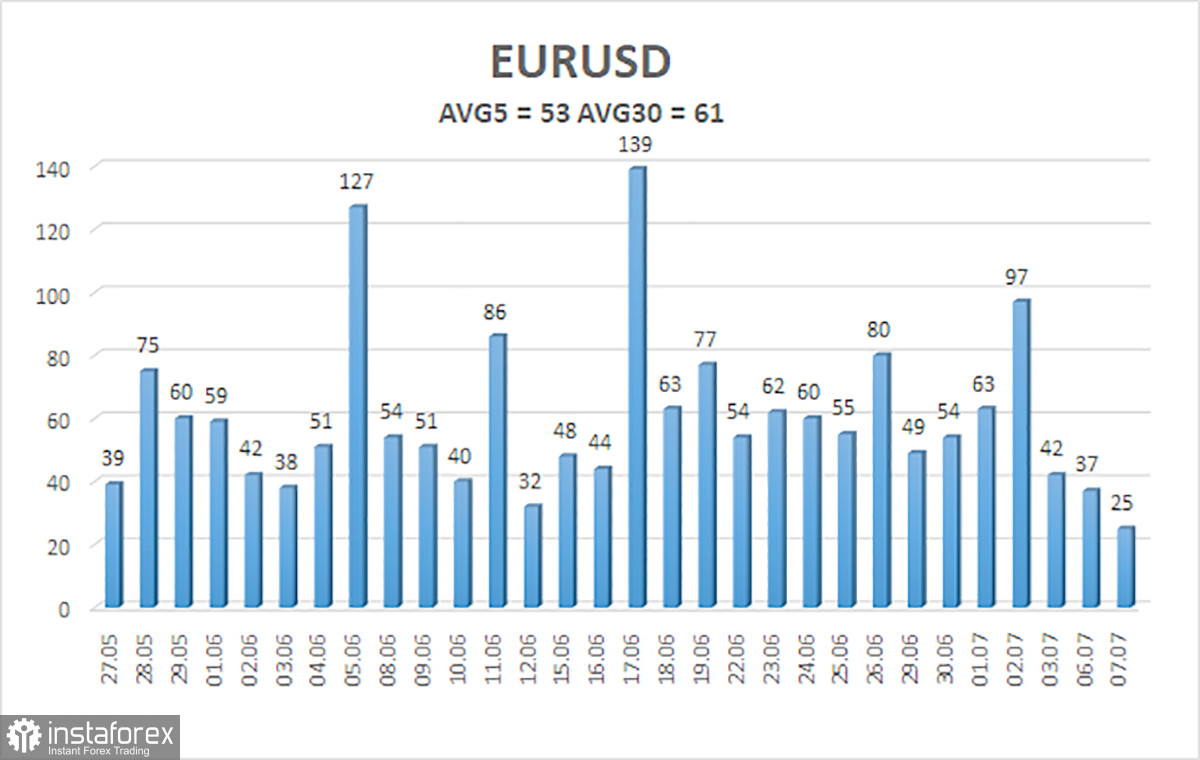
The average volatility of the EUR/USD currency pair over the last five trading days as of July 8 is 53 pips, which is considered "average." We expect the pair to move between 1.1375 and 1.1481 on Wednesday. The upper channel of the linear regression has turned downwards, indicating the continuation of the downward trend. The CCI indicator has entered the oversold area and formed two "bullish" divergences, warning of a potential end to the downward trend.
The EUR/USD pair maintains a downward trend, presumed to be a correction within a broader upward trend, as visible on the daily or weekly timeframe. The global fundamental background for the dollar remains negative, but in 2026, geopolitics and the Fed's hawkish stance have provided powerful support for the American currency. If the price is below the moving average, consider short positions targeting 1.1353 and 1.1292. Long positions are relevant above the moving average with targets at 1.1475 and 1.1536. Bears currently appear very strong for no visible reason.


