
See also


 17.03.2026 12:47 AM
In reality, I do not believe that the conflict in the Middle East will drag on for many months or even years. There are several reasons for this. Already now, the European Union is demonstrating intentions to establish contact with Iran and to show that it does not personally support Donald Trump's military ambitions. According to unofficial information, Italy and France have already begun direct negotiations with Tehran to unblock the Hormuz Strait for their own tankers. If the blockade is lifted even partially, oil will begin to flow back into global markets, lowering prices and increasing supply. This certainly will not completely solve the energy problem, but it's at least a step forward.
Trump, meanwhile, continues to lash out, but not against Iran, where, in his opinion, the US Navy and Air Force have accomplished about 90% of their objectives, but rather against the European Union. Brussels has made it clear that it is not going to clean up the ashes with its own hands so that Washington can enjoy baked potatoes. Iranian missiles may not reach America, but they are fully capable of hitting Europe. America has enough of its own oil and gas, while Europe is heavily dependent on energy imports. The war was started by Trump, and now the US President passionately wishes to drag Europe into it as well, so as to achieve Iran's capitulation by foreign hands and with minimal losses for America itself.
Trump understands that the longer the war in Iran continues, the greater the financial and military losses borne by America itself. War is a very expensive endeavor, and the US budget remains in deficit, with national debt continuing to grow almost exponentially, and Trump's political ratings have fallen to their lowest levels during both of his terms in office. The leader of the White House must realize that the necessity of casualties among American soldiers and expensive equipment will have to be somehow explained to American voters and taxpayers. Many of them are already dissatisfied with the explanation along the lines of "Iran has nuclear missiles, so they need to be destroyed." Many countries possess nuclear missiles. Should they all be destroyed?
Moreover, it is precisely the nuclear missiles, fuel, plants, enriched uranium, and technologies that Trump has not been able to eliminate, either last summer or in the spring of 2026. At least because all of the above is located at secret sites throughout Iran, deep underground. Therefore, it is possible to bombard and strike Iran with bombs and missiles, but there can be no confidence in the complete destruction of its nuclear potential. Additionally, it is not enough to destroy nuclear stockpiles and missiles; it is necessary to ensure that Iran does not resume their development and construction. For this reason, Trump wants to overthrow the current regime in Iran, which appears to be an even more unachievable task, given the size of Iran, its population, and the country's geographical features.
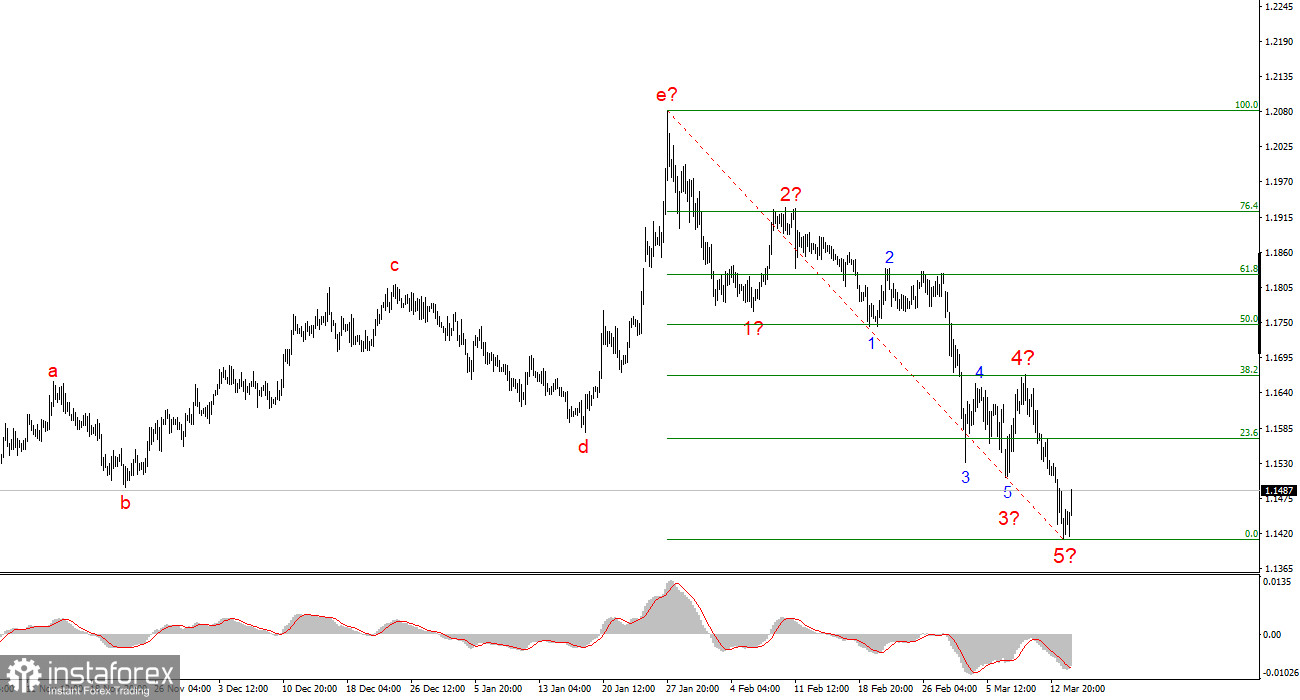
Based on my analysis of EUR/USD, I conclude that the instrument remains within an upward segment of the trend (lower chart), but in the short term, it has begun forming a downward segment of the trend. Since the five-wave impulse structure has been completed, my readers can expect a price increase over the next week or two, with targets around 1.1568 and 1.1666, which correspond to the 23.6% and 38.2% Fibonacci levels. Further movements of the instrument fully depend on developments in the Middle East.
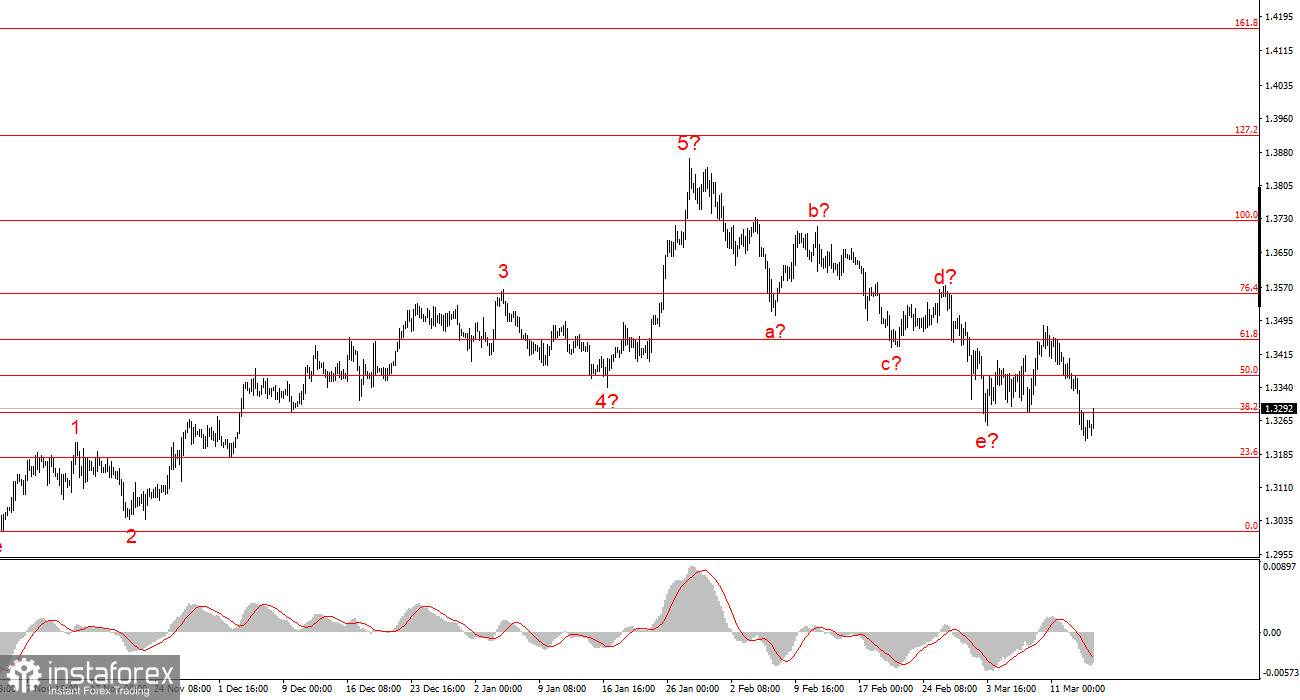
The wave picture of the GBP/USD instrument has become very complex and difficult to read. We now see a seven-wave downward structure on the charts, which is certainly not such. Most likely, there is an extension or complication within one of the waves. However, this does not make the wave count clearer. If the wave picture has once become complicated to the point of unreadability, it can become complicated again several times. Therefore, I believe that one should currently rely on the wave count of the EUR/USD instrument, which looks much more understandable. Also, do not forget the geopolitical factor, which can send both instruments into a new decline at any time. If this does not happen, the euro and the pound may see a slight increase within the context of a correction.


