
See also


 23.06.2026 03:52 AM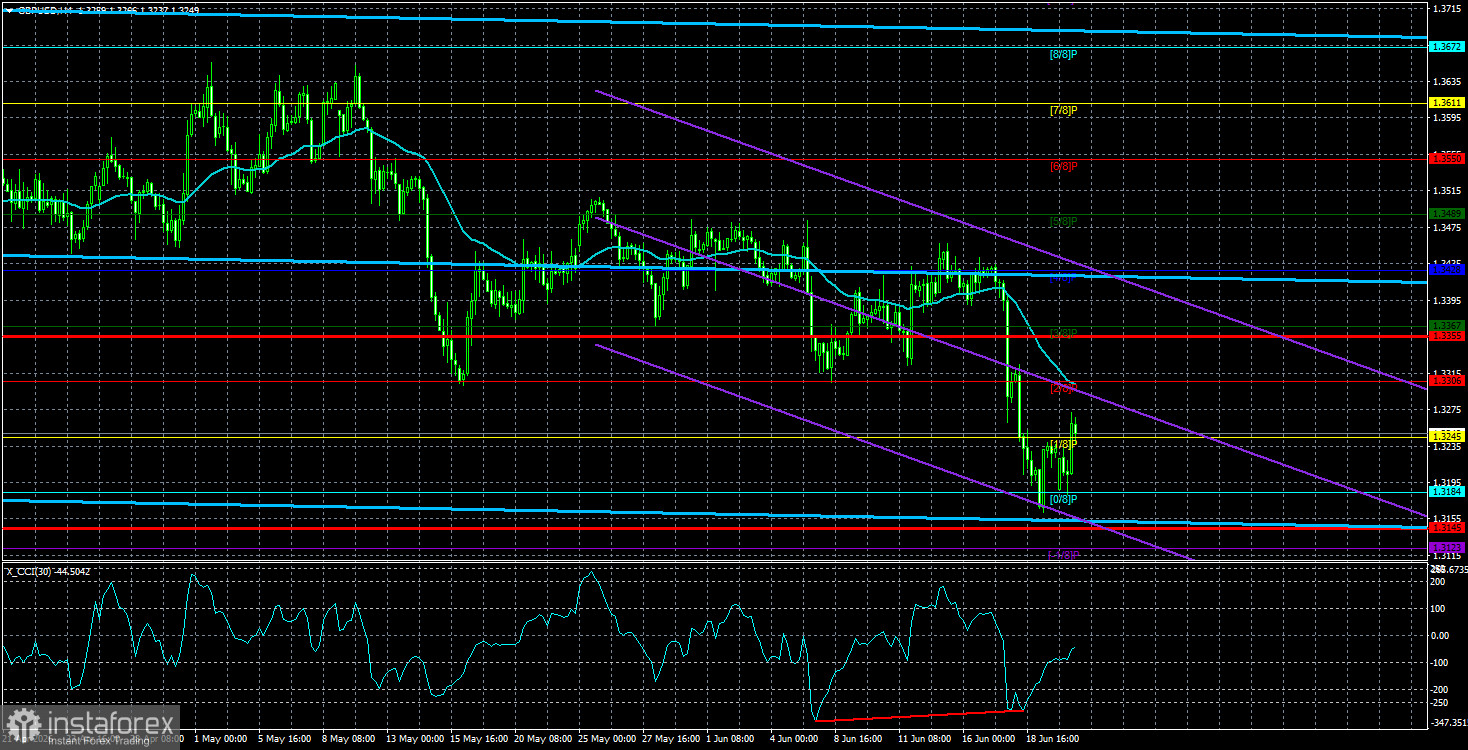
The GBP/USD currency pair began rising on Monday afternoon, in stark contrast to the EUR/USD pair, which remained stagnant at the same time. It became known on Monday that UK Prime Minister Keir Starmer has decided to resign. Recall that a month ago, the market was actively "pricing in" the Labour Party's defeat in local elections, many ministers from Starmer's government resigned, and some party members publicly called for Starmer to step down. Therefore, firstly, it can be said that the resignation of another prime minister had long been anticipated.
Secondly, we do not believe that the market sold off the British pound in light of this event. Over the last ten years, Britain has seen six prime ministers come and go. Thus, another minister's resignation has made for a "boring Monday" in the UK. However, the British pound rose confidently on Monday, which can only mean one thing: the market, by contrast, welcomes the Labour leader's resignation.
Most experts believe that Starmer's government has failed to meet the tasks set before it. The results of Starmer's tenure are best reflected in the elections. If, two years ago, Starmer won with a significant lead, over the subsequent two years, he lost, if not all, then the majority of voters' trust. Andy Burnham, the Mayor of Greater Manchester, is expected to become the new Prime Minister, as he actively supports expanding social and medical support for citizens, which is why he is popular with the public. Burnham believes that the government should address pressing issues without compromising the standard of living for the British population. Therefore, many currently believe that Burnham will indeed become the new Prime Minister. It is interesting to see how long he will last in this position.
On Monday, the British pound disregarded geopolitics and focused on internal political developments. In recent weeks, the British currency has been falling quite actively, as the Bank of England abandoned plans to tighten monetary policy due to weak inflation, while the Fed, on the other hand, took a somewhat more "hawkish" stance than expected. Recall that Kevin Warsh's rise to power was associated with a softening of policies that Donald Trump demanded. However, Warsh indicated that it is essential to restore inflation to the target level by any means necessary, implying an increase in the key interest rate. Although the tightening process may not begin until September, when Warsh could devise a brilliant plan to delay rate hikes, the market currently believes in tightening in the U.S. but not in Great Britain.
However, we want to note that this situation cannot continue indefinitely. The British pound does not look so bleak that it will keep falling. On the daily and weekly timeframes, upward trends still persist, the Federal Reserve's tightening is not a foregone conclusion, and the BoE may return to "hawkish" views as soon as inflation in the UK starts to rise again. Economists and bankers assure us that it will. Therefore, the pound is not as hopeless as it may seem, and it has been declining within a flat range on higher timeframes for two months...
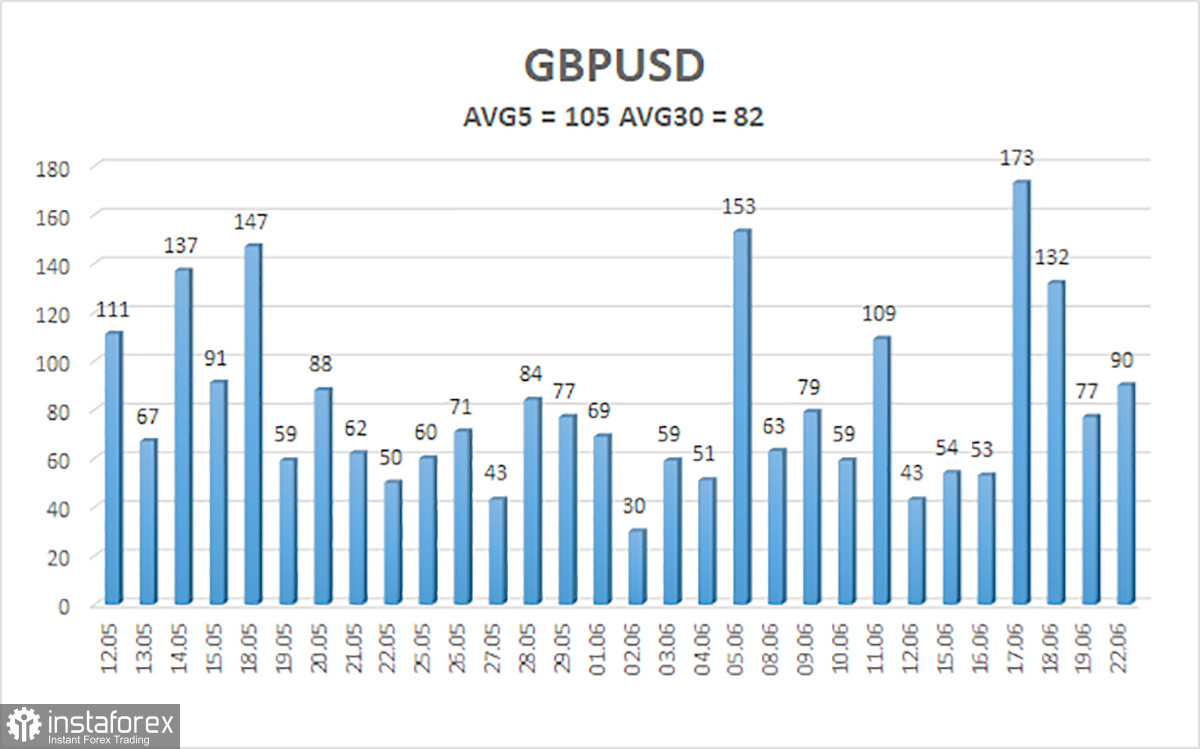
The average volatility of the GBP/USD pair over the last five trading days is 105 pips. For the pound/dollar pair, this value is considered "average." On June 23, we thus expect movement within the range bounded by 1.3145 and 1.3355. The upper linear regression channel is moving sideways, indicating trend uncertainty. The CCI indicator has entered the oversold area for the second time and formed a "bullish" divergence, warning of a possible end to the downward trend.
S1 – 1.3245
S2 – 1.3184
S3 – 1.3123
R1 – 1.3306
R2 – 1.3367
R3 – 1.3428
The GBP/USD currency pair maintains a downward trend. Trump's policies will continue to put pressure on the U.S. economy, so we do not expect long-term growth in the U.S. dollar. The year 2026 is turning out to be super-positive for the dollar due to geopolitics and, more recently, the Fed's readiness to raise the key interest rate. Long positions with targets at 1.3428 and 1.3489 can be considered when the price is above the moving average. A price position below the moving average line will allow for bearish trades targeting 1.3184 and 1.3145.
Linear regression channels help determine the current trend. If both are directed in the same direction, it indicates a strong trend;
The moving average line (settings 20,0, smoothed) defines the short-term trend and the direction in which trading should currently be conducted;
Murray levels are target levels for movements and corrections;
Volatility levels (red lines) indicate the likely price channel in which the pair will spend the next day based on current volatility indicators;
The CCI indicator entering the oversold area (below -250) or the overbought area (above +250) indicates that a trend reversal in the opposite direction is approaching.


