
Lihat juga


 17.08.2026 08:54 AM
A new breath has opened up for the euro, pound, and other risky assets.
On Friday, the dollar fell after U.S. retail sales dropped 0.6% in July, marking the worst performance in over a year. Excluding automobiles and gasoline, the decline was 0.2%, with online shopping taking the biggest hit. Retail sales reflect consumer activity, a significant part of the U.S. economy, so a weak report weakened the case for hawkish Federal Reserve policy and deprived the dollar of support. The weakening dollar provided support for the euro and pound, and both European currencies strengthened. However, the sustainability of their growth depended on whether the market viewed consumer weakness as temporary or structural.
Today, there are no reports expected for the eurozone in the first half of the day, and the only event will be a speech by European Central Bank representative Philip Lane. The comments from ECB members are usually important as the market gauges the central bank's mood through them and adjusts rate expectations. However, this time, it is unlikely that serious changes in the power dynamics will come from them. As the chief economist of the ECB, Lane can set the tone, but in the absence of new signals, his words are likely to be received with restraint.
In such conditions, the single currency will remain dependent on external factors. While there are no significant internal factors, the EUR/USD pair will primarily focus on the dollar's behavior and overall risk appetite, rather than on Lane's speech itself. The euro can only be noticeably affected by an unexpectedly hawkish or dovish message from Lane. At the same time, neutral statements will leave the dynamics unchanged until the end of the European session.
For the pound, there are also no relevant reports, so it will be entirely tied to traders' attitudes towards the U.S. dollar, whose weakness in recent weeks has helped the GBP/USD pair rise.
If the data aligns with economists' expectations, it is better to act based on the Mean Reversion strategy. If the data is significantly above or below economists' expectations, it is best to use the Momentum strategy.
Buying on a breakout at 1.1592 could lead to the euro rising to around 1.1618 and 1.1645;
Selling on a breakout at 1.1566 could lead to the euro falling to around 1.1541 and 1.1514;
Buying on a breakout at 1.3558 could lead to the pound rising to around 1.3581 and 1.3617;
Selling on a breakout at 1.3527 could lead to the pound falling to around 1.3501 and 1.3475;
Buying on a breakout at 159.13 could lead to the dollar rising to around 159.39 and 159.60;
Selling on a breakout at 158.83 could lead to a dollar sell-off to around 158.57 and 158.28;
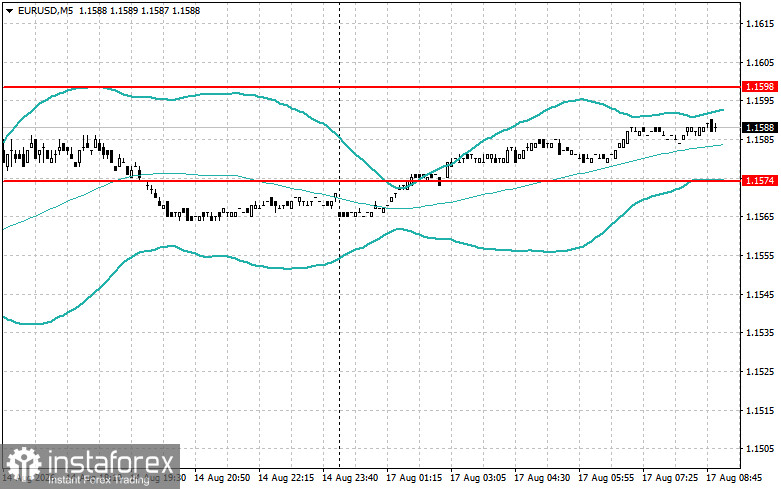
I will look for short positions after a failed breakout above 1.1598 on a return below this level;
I will look for long positions after a failed breakout below 1.1574 on a return to this level;
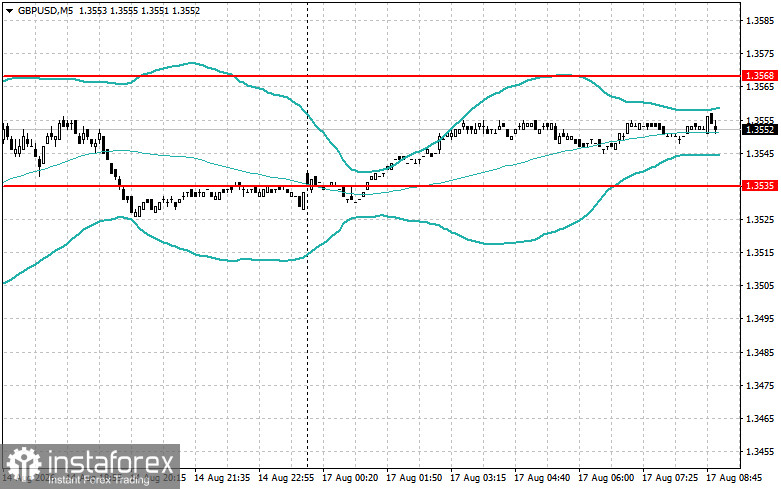
I will look for shorts after a failed breakout above 1.3568 on a return below this level;
I will look for longs after a failed breakout below 1.3535 on a return to this level;
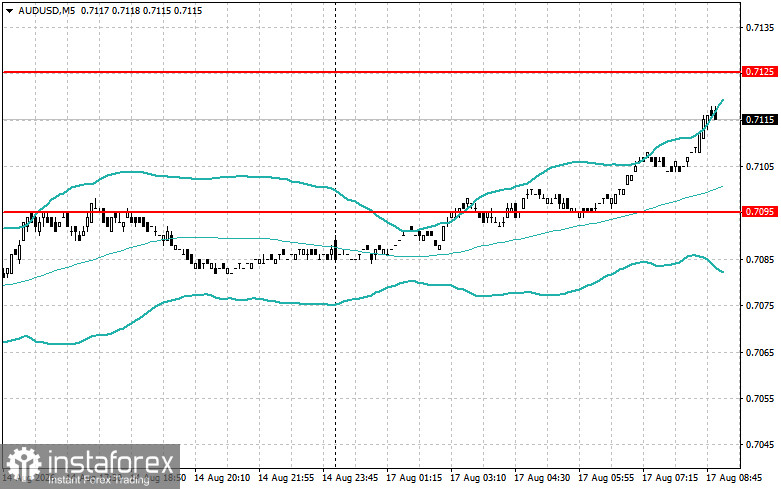
I will look for shorts after a failed breakout above 0.7125 on a return below this level;
I will look for longs after a failed breakout below 0.7095 on a return to this level;
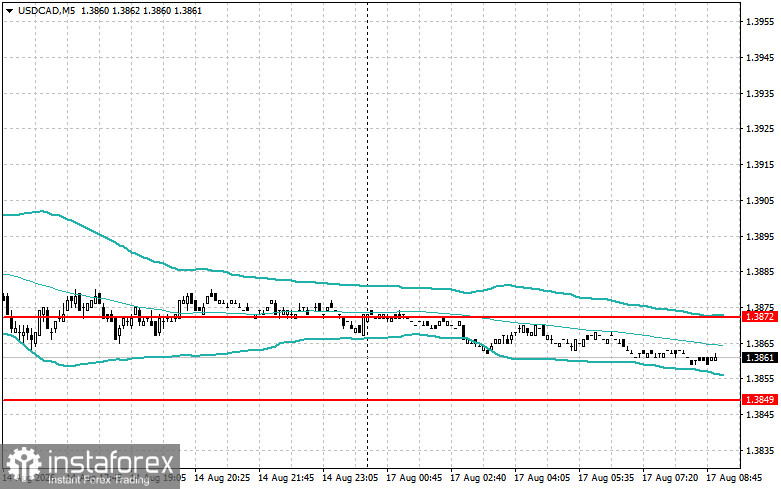
I will look for shorts after a failed breakout above 1.3872 on a return below this level;
I will look for longs after a failed breakout below 1.3849 on a return to this level;


