
यह भी देखें


 13.07.2026 01:55 PM
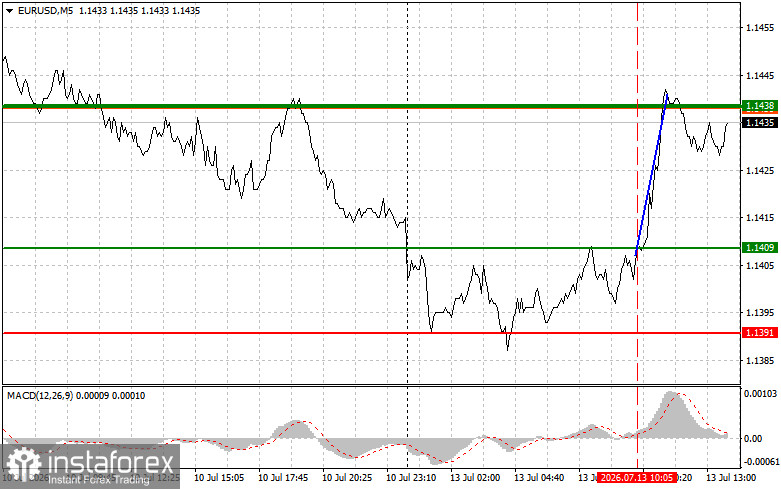
The test of the 1.1409 level occurred when the MACD indicator had just begun moving higher from the zero line, confirming a valid buy entry for the euro. As a result, the pair advanced toward the 1.1438 level.
As the chart shows, the U.S. dollar's morning rally proved short-lived, and by the middle of the session it had surrendered its gains against risk-sensitive assets. The initial demand for the dollar, driven by concerns over the U.S.-Iran conflict, gradually faded as market anxiety eased. Investors who had initially sought safety in the dollar shifted their focus back to higher-yielding assets.
The euro and the U.S. dollar are likely to spend the second half of the day awaiting speeches by FOMC members Michelle Bowman and Christopher Waller, as no other major U.S. economic releases are scheduled. Under these circumstances, Federal Reserve rhetoric becomes the primary market driver, since it shapes expectations for the future path of interest rates. If Bowman and Waller reaffirm the Fed's commitment to maintaining a restrictive monetary policy, the U.S. dollar is likely to strengthen, putting pressure on the euro. Conversely, more cautious remarks could weaken demand for the dollar and give the single currency an opportunity to extend its recovery toward this week's high.
As for my intraday trading strategy, I will primarily rely on the execution of Scenario No. 1 and Scenario No. 2.
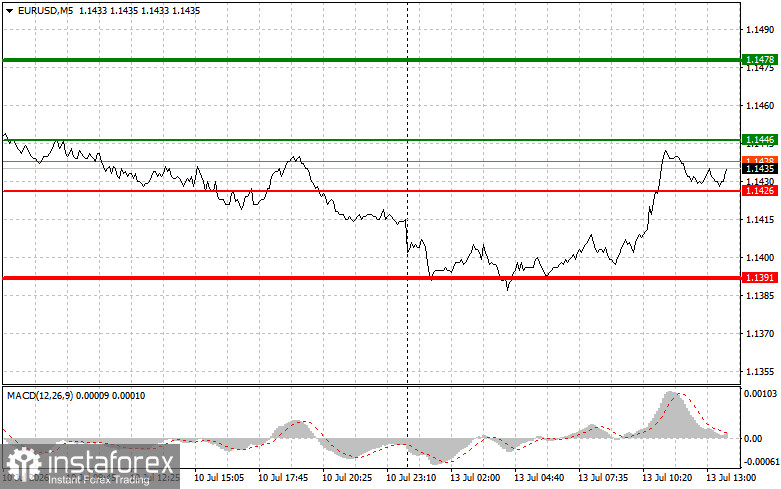
Buy the euro if the price reaches 1.1446 (the green line on the chart), targeting 1.1478. At 1.1478, I plan to close long positions and immediately consider opening short positions, anticipating a 30–35 point pullback from the entry point.
The euro is likely to rise today if Federal Reserve officials deliver dovish comments.
Important: Before opening a long position, make sure that the MACD indicator is above the zero line and is just beginning to move higher.
I also plan to buy the euro if the price tests 1.1426 twice consecutively while the MACD indicator is in oversold territory. This would limit the pair's downward potential and signal a bullish market reversal. In this case, the upward targets would be 1.1446 and 1.1478.
I plan to sell the euro after the price reaches 1.1426 (the red line on the chart), targeting 1.1391. At 1.1391, I intend to close short positions and immediately consider opening long positions, expecting a 20–25 point rebound.
Selling pressure is likely to return if Federal Reserve officials deliver hawkish comments.
Important: Before opening a short position, make sure that the MACD indicator is below the zero line and is just beginning to move lower.
I also plan to sell the euro if the price tests 1.1446 twice consecutively while the MACD indicator is in overbought territory. This would limit the pair's upward potential and trigger a bearish reversal. In this case, the downward targets would be 1.1426 and 1.1391.
Beginner Forex traders should exercise caution when making market entry decisions. It is generally advisable to stay out of the market ahead of major economic releases to avoid exposure to sharp price swings. If you decide to trade during the release of economic news, always use stop-loss orders to limit potential losses. Trading without stop-loss protection can quickly result in substantial losses, particularly when using large position sizes without proper risk management.
Finally, successful trading requires a clear and disciplined trading plan, such as the one outlined above. Making spontaneous trading decisions based solely on current market fluctuations is generally a losing strategy for intraday traders.

