
Lihat juga


 25.09.2026 07:20 PM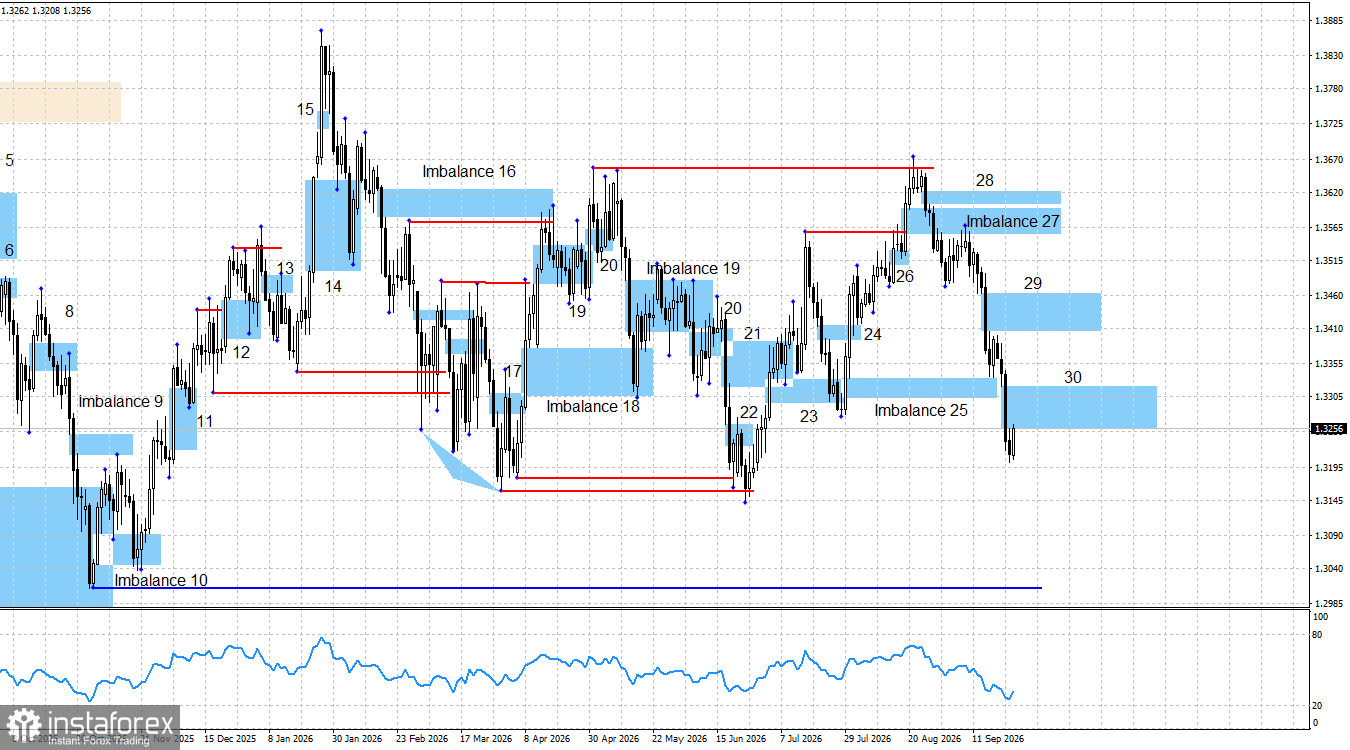
The GBP/USD pair continues to fall almost freely. Over the past 11 days, bullish traders have made only one attempt to counter the bears. Today, we saw the long-awaited corrective retracement, which could end as early as next week, as the new Imbalance 30 zone is now acting as resistance above the price. Over the past three weeks, the bears have attacked with virtually no resistance from the bulls. I would like to remind you that the US currency's rise began even before the latest FOMC meeting, ahead of which the market was effectively demanding tighter monetary policy. This week, FOMC officials Thomas Barkin, John Williams, Susan Collins, and others added fuel to the fire by confirming their intention to continue raising interest rates because inflation remains excessively high. The market has focused on the Fed's tightening policy and has continued to buy the dollar steadily for three consecutive weeks. At present, neither technical patterns nor the economic backdrop are capable of stopping the decline. Only the bears themselves can stop the bears.
I would also note that, at the same time, traders expect the Bank of England to implement the same two monetary policy tightenings over the next six months. This week, Deutsche Bank revised its forecast for the UK regulator's interest rate, and the market agrees with it. This means that, according to market expectations, the Fed should raise rates twice, and the Bank of England should also raise rates twice. The result: the dollar rose for 11 consecutive days.
Despite the unfavorable picture for the British pound that has developed in recent weeks, the dollar has also faced numerous adverse factors in recent months. If the Fed had not decided to raise interest rates in September and had not signaled its willingness to tighten policy at least once more by the end of the year, I would still expect the US currency to decline. I still expect it, but from lower levels. However, this week, bullish Imbalance 25 was invalidated, and the bulls' chances now lie solely in taking liquidity from the low of July 28 or June 24. The chart clearly shows that most reversals over the past year occurred precisely after liquidity was taken, so in my view, this represents an opportunity. The bears, meanwhile, now have two strong imbalances at their disposal—29 and 30. Particular attention should be paid to the latter, as it has already essentially been worked through. This means that the decline could very well resume as early as next week.
Are there further prospects for the bears? In my view, there are few, but it should be acknowledged that the dollar remains in a favorable period. The Fed not only decided to raise rates but also communicated its willingness to continue tightening to traders this week. I do not believe that a prolonged decline in GBP/USD can be driven by this factor alone; however, over the past few weeks, the market has done little but price in the FOMC rate hike. What could prevent it from continuing to buy the dollar for several more weeks amid the Fed's monetary tightening?
Technical analysis shows that the picture became fully bearish after liquidity was taken from the May highs. The pound reacted to bearish Imbalance 27, triggering a 320-point decline in the pair. The decline targeted Imbalance 25, and this pattern was both worked through and broken. New bearish imbalances 29 and 30 were also formed this week.
The economic backdrop on Friday allowed bearish traders to continue their advance, but they eventually took a pause. This happened precisely on a day when the economic backdrop supported another rise in the dollar, unlike all the previous days of the week. I understand that statements by FOMC members regarding tighter monetary policy are fairly strong reasons to buy the dollar, but in my view, the market is once again pricing in an excessively hawkish scenario for the US currency.
The overall information backdrop remains such that, in the long term, I cannot expect anything other than a decline in the US currency. The war between Iran and the United States has not changed my long-term expectations. Geopolitical factors prompted the market to recall the dollar's safe-haven status for several months, but the conflict has already passed its most active phase. The future course of FOMC monetary policy remains uncertain, while the market continues to anticipate only further tightening, which is the main reason for the bears' positive sentiment. In my view, any rise in the dollar is temporary and driven by short-term factors. I would also note that GBP/USD has been trading in a range for an entire year. A range allows for virtually any price movement within its boundaries. Traders have not yet managed to break out of the range.
US and UK Economic Calendar:
On September 28, the economic calendar contains no significant events. The economic backdrop will have no impact on market sentiment on Monday.
GBP/USD Forecast and Trading Advice:
The long-term outlook for the pound remains bullish. The bears have taken the initiative in recent weeks, but overall, the range is visible even on the daily chart. Taking liquidity from the swing high of May 1 triggered the decline; a sell signal formed within Inverted Imbalance 27, followed by another bearish signal within the same pattern. The price reaction to Imbalance 25 prompted traders to close their short positions, but the bulls never launched an advance. Thus, the pound continues to fall almost freely, and the decline could continue toward the June lows, from which liquidity could be taken, followed by a reversal in favor of the pound. However, at present, the price could react to the nearest bearish Imbalance 30.


