
یہ بھی دیکھیں


 15.12.2025 11:16 AM
Recent days have presented a true test for traders and investors, as global financial and technological markets have been engulfed in instability, reflecting a wide array of economic, political, and technological trends.
Bitcoin is undergoing a sharp correction, losing almost a third of its value and triggering a wave of liquidations, despite ongoing interest from institutional players. At the same time, gold is hitting multi-week highs amid the Fed's easing policies, raising concerns about overheating in the
precious metals market. In the technology sector, a new confrontation is rapidly unfolding as China reduces its lag behind the US in the race for leadership in artificial intelligence, showcasing its technological breakthroughs and substantial government support.
In this article, we will explore the interconnections between these events, highlight key market trends, and discuss how traders can capitalize on the current volatility.
Bitcoin's Instability: strong sell-off erases 2025 gains

A new wave of instability has hit the cryptocurrency market: on December 14, Bitcoin was trading around the $90,000 mark, having lost nearly 29% from its all-time high of $126,000 reached in October. This decline is part of a protracted downward trend that has completely negated the annual growth and once again raised questions about the cryptocurrency's role as a store of value.
According to YCharts, the day closed at $90,257, symbolically underscoring how quickly the euphoria that gripped the digital market just two months ago has dissipated. Instead of growth prospects, we are witnessing volatility, mass liquidations, and new signs of vulnerability in digital assets.
In recent weeks, the market has experienced a series of significant liquidations, exacerbating the plight of investors. One of the key and most resonant events occurred on October 10 when news of US President Donald Trump's imposition of a 100% tariff on Chinese imports caused Bitcoin to plunge by 14%, settling around $105,000. At that time, over $19 billion in leveraged positions were liquidated, marking a historic crash for the cryptocurrency segment.
A new wave of forced sales swept through the market in December, resulting in the closure of more than $400 million in margin positions across major assets. Investors were caught off guard by this new reality, where market whales are forced to either sell or seek ways to strengthen their positions.
Amid the market catastrophe, humor resurfaced. Strategy co-founder Michael Saylor, known for his active support of Bitcoin, captured attention with a satirical image portraying him as a McDonald's employee with the caption " Will work for Bitcoin." The meme quickly went viral, prompting both support and criticism.
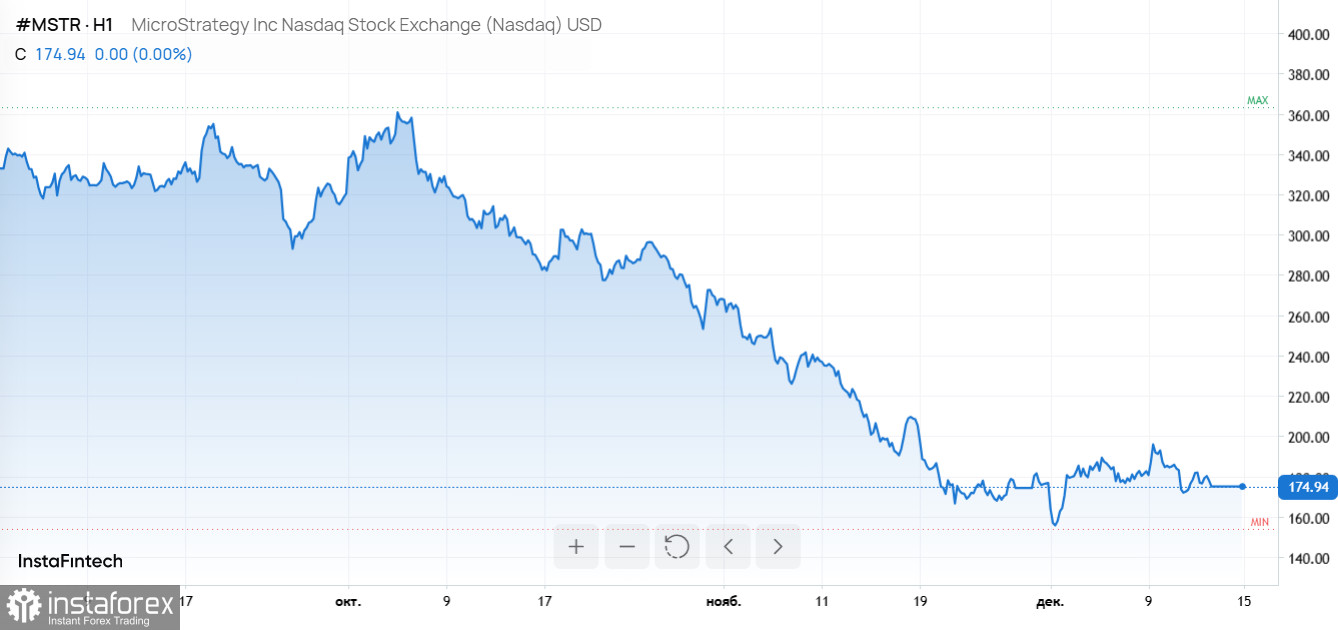
Last week, Strategy purchased another 10,624 bitcoins for approximately $963 million, bringing its total holdings to a substantial 660,624 coins. Additionally, the company has prepared a cash safety cushion of $1.44 billion—just in case dividend payouts and market risk mitigation are necessary.
Bitcoin's sharp drop to $90,000, accompanied by a wave of liquidations and unstable macroeconomic news, once again confirms that the cryptocurrency market operates under its own rules. Despite the deep correction, institutional players like Strategy continue to accumulate positions, demonstrating long-term faith in the potential of digital assets.
For traders, this may signal a strategic entry point. Typically, periods of high volatility open up a unique opportunity for short-term speculation and for establishing long-term investment positions at reduced prices.
Traders can benefit by utilizing tools such as leveraged trading, opening short or long positions, and using analytics to identify reversal points. Stop-losses and take-profits are especially effective in conditions of heightened volatility.
The trading instruments mentioned in this article, including Bitcoin, are available for trading on the InstaTrade platform. To capitalize on the fluctuating market, open a trading account with InstaTrade now, and for more convenient trading, follow the markets in real time using the company's mobile app.
Who prevents Bitcoin's growth?

Despite a noticeable increase in interest from institutional investors and steady capital flows into Bitcoin through exchange-traded funds (ETFs), the price of the leading digital currency remains stuck in a narrow range. As it turns out, this tense market dynamic is influenced not only by external factors but also by the strategic actions of Bitcoin holders themselves. One key factor is the active use of covered call strategies by long-term investors.
According to Jeff Park, Chief Investment Officer at ProCap BTC, it is the "OG investors"—those who have held Bitcoin for over ten years—who are playing a crucial role in shaping the market. They are widely employing the covered call strategy, selling call options on assets they already own. This allows them to profit from options premiums, but it inadvertently increases pressure on the spot market.
As of December 14, Bitcoin was trading at $90,257, approximately 10% lower than a year ago and only slightly off the previous day's price. The price has failed to break through the strong resistance in the $90,000 to $94,000 zone, despite positive inflows from ETFs and other major players.
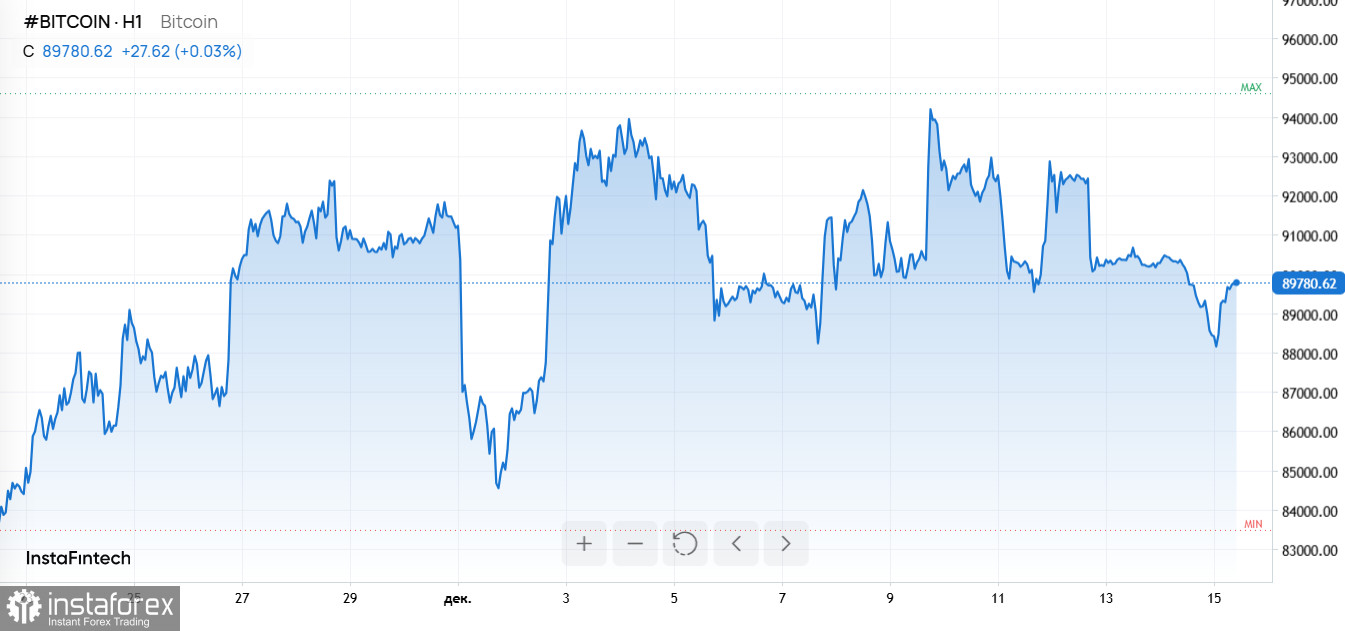
The situation is exacerbated by the active role of the options market. According to analysts, approximately $23.8 billion in Bitcoin options will expire on December 26, encompassing both quarterly and annual contracts. The most significant positions are concentrated at two levels: put options priced at $85,000 covering 14,674 BTC, and call options at $100,000 covering 18,116 BTC. This concentration of positions creates what is known as the implied pressure from above and a supporting cushion from below, making price movement difficult in either direction.
Park emphasizes that as long as the whales continue to extract short-term profits by selling covered calls, the price dynamics of Bitcoin will remain unstable. Market makers, acting as counterparties to these call options, must hedge their risks by selling Bitcoin on the spot market. This results in increased supply and limited growth potential.
At present, Bitcoin remains under the influence of a complex market strategy employed by long-term holders. Despite institutional interest, the price is constrained by the mass selling of call options, which creates technical pressure on the market.
For traders, this situation presents opportunities. For instance, active trading within the $85,000 to $100,000 range could be quite profitable when utilizing derivatives. Combinations of strategies, including buying puts or selling calls, can also take advantage of market volatility. Furthermore, analyzing open interest in options allows traders to identify key resistance and support levels, making it ideal for medium-term speculation and risk hedging.
Gold Hits 7-week high: Market ignores bubble warnings

Amid the US Federal Reserve's decision to cut interest rates, gold has experienced a swift rise, reaching new seven-week highs. Despite concerns from leading global financial institutions regarding overheating conditions in the precious metals market, the metal maintains a confident upward trend. In this article, we will explore the reasons and consequences of this rally and discuss how traders can capitalize on the current situation.
Last week, gold prices reached $4,293 per ounce, and by Monday, spot gold was trading around $4,305, securing a weekly gain of over 2.6%. This surge was prompted by the Fed's third consecutive rate reduction of 25 basis points to a range of 3.50% – 3.75%.
The current situation has caused considerable resonance within the Federal Open Market Committee. The decision to lower rates was made amid significant dissent, with three committee members opposing it—an unprecedented occurrence in the past six years.
Another boost for gold's rise came from the weakening US dollar, which fell to an eight-week low. The decline in the American currency typically enhances gold's appeal as an alternative asset.
Despite the strong growth in precious metals, the Bank for International Settlements (BIS), often referred to as the central bank for central banks, issued a sharp warning on December 8. The report notes that the simultaneous explosive growth of both gold and US stocks is being observed for the first time in 50 years, which is a potential sign of a bubble.
BIS economic advisor Hyun Song Shin emphasized the unusual behavior of gold in 2023, pointing out its similarity to highly speculative assets. Statistical models used by BIS are identifying bubble dynamics but cannot precisely indicate when a correction might occur.
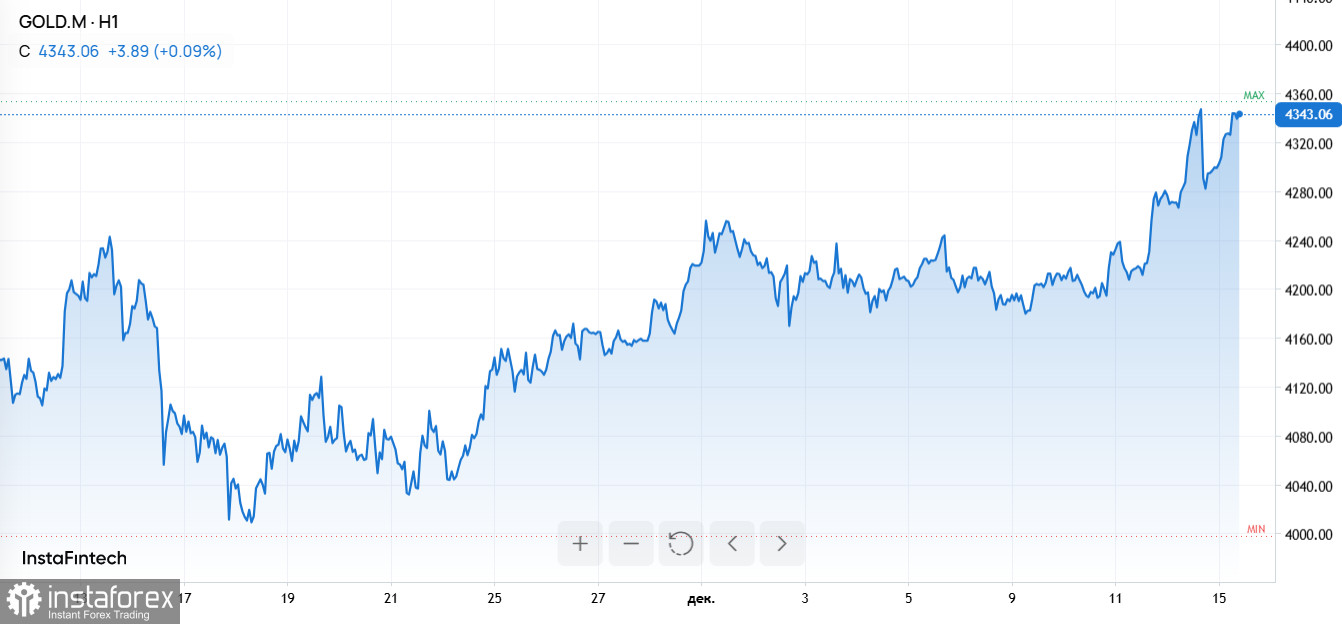
While regulators are issuing warnings, investors are actively increasing their positions. In November, global gold ETFs recorded a net inflow of $5.2 billion—marking the sixth consecutive month of positive dynamics.
Following gold, silver is also experiencing strong growth: on December 12, the metal reached a price above $64 per ounce—an all-time record. Since the beginning of the year, silver has risen by over 100%.
Goldman Sachs maintains an optimistic outlook on gold's prospects, predicting a rise to $4,900 per ounce by the end of 2026. Experts highlight that gold's share in American investors' portfolios remains historically low, and even a slight increase in investments could significantly impact prices. Additionally, robust drivers remain in the form of central bank purchases and steadily increasing inflows into ETFs.
Key takeaways and how traders can profit:
1. Gold and other precious metals are displaying a powerful rally supported by interest rate cuts, a weaker dollar, and ongoing demand.
2. Despite concerns regarding a market bubble, investors are currently reluctant to lock in profits.
3. Disagreements within the Fed are creating additional uncertainty, which also fuels demand for safe-haven assets.
For traders, the current situation presents an excellent opportunity to profit from short-term price fluctuations or to build medium-term positions with an expectation of further growth.
All instruments discussed in this article are available for trading on the InstaTrade platform. To start profiting from price movements, open a trading account today. For added convenience, use the InstaTrade mobile app—it is an easy way to stay one step ahead of the market.
China quickly catches up to US in AI race: DeepSeek breakthrough and government strategy

China is rapidly closing the technological gap with the US in the field of artificial intelligence (AI). Against the backdrop of intensifying rivalry between the two global economies, the Asian giant has made significant strides: over the past year, the productivity gap in AI models between China and the US has reduced by 4.5 times. Recent developments from Chinese companies, including the startup DeepSeek, are producing results comparable to cutting-edge solutions from OpenAI and Meta, thus shifting the balance in the global technology race.
At the end of December 2024, the Chinese startup DeepSeek unveiled its latest language model, DeepSeek-V3, and by January 2025, it introduced the high-performance reasoning model R1. Both developments have been recognized by experts as comparable in performance to flagship AI systems from leading American tech companies, according to a recent analysis by the South China Morning Post.
The breakthrough from DeepSeek is particularly significant: back in January 2024, the difference in test scores between top AI models from China and the US was 103 points. However, by February 2025, this gap narrowed to just 23 points. Analysts view this leap as the beginning of a new phase in the competition between the powers.
Despite ongoing restrictions from the US blocking the export of advanced graphics processors and AI chips, Chinese companies are finding ways to circumvent resource shortages. This includes developing more energy-efficient and cost-effective methods for training models. For instance, the R1 model from DeepSeek achieved performance levels similar to OpenAI's o1, reportedly trained with far less computational power.
Government support in China plays a key role in this process. At the Central Economic Work Conference held in December 2024 in Beijing, artificial intelligence was officially declared a national priority for 2026. The "AI Plus" program was launched to implement AI technologies in key economic sectors such as transportation, healthcare, and industry.
According to government sources, a 70% penetration of AI-based systems into major industries is expected by 2027. As noted by Zhong Xinlun, director of the AI Research Laboratory at the Chinese Center for Information Industry Development, current developments go beyond generative language models. They involve smart cities, autonomous vehicles, industrial robots, and next-generation software.
Simultaneously, major tech giants in the country, such as Alibaba and Baidu, have begun developing their own AI chips, reducing dependence on Western manufacturers, including Nvidia. China has also introduced a distributed network of AI data processing centers spanning 2,000 kilometers, boasting up to 98% efficiency compared to their American counterparts.
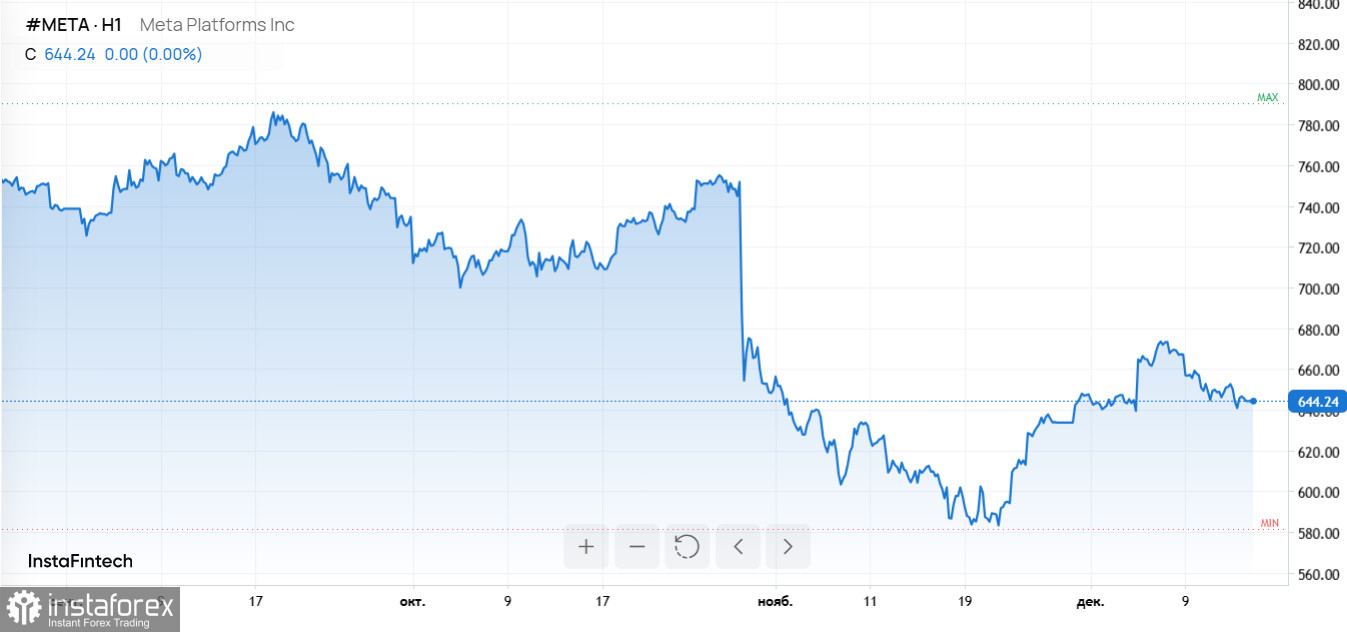
Nonetheless, the US retains a significant advantage in infrastructure. As of mid-2025, the US accounts for 74% of global AI computational power, while China only controls 14%. American companies also produce about 20 times more high-performance chips. However, experts believe that resource constraints may serve as a catalyst for innovation in China.
It is noteworthy that when OpenAI released ChatGPT in November 2022, China reacted swiftly: officials began requesting analytical summaries, and universities started developing prototypes. Although venture investors like Allen Zhu Xiaohu initially expressed skepticism about the profitability of AI startups in China, by the end of 2025, the situation had changed dramatically—the technological gap between the US and China is now measured in months rather than years.
Key takeaways:
1. China is rapidly narrowing the gap in AI development with the US thanks to robust innovations, government investments, and technological adaptations to export restrictions.
2. New approaches to energy-efficient AI training could prompt traders to reassess strategies and focus on Chinese tech companies.
3. The success of DeepSeek signals growing competition in the AI market, which may lead to volatility in the stocks of both Chinese and American tech developers.
How traders can leverage the situation:
1. Consider investing in Chinese tech companies (such as Alibaba and Baidu) that are focusing on developing their own AI chips.
2. Monitor American competitors (like Nvidia, Meta, and OpenAI) for the market's response to the rise of Chinese competition.
3. Utilize technical analysis tools to evaluate short-term fluctuations driven by news related to AI and develop corresponding trading strategies.
All trading instruments discussed in this article are available for trading on the InstaTrade platform. To start trading, open a trading account on the company's website. Additionally, you can download the InstaTrade mobile app to stay updated on market news and respond quickly to any changes in the markets.


