
یہ بھی دیکھیں


 26.03.2026 01:00 AM
On Wednesday, the British pound (GBP) moved downward during the day, while the US dollar slightly strengthened amid decreasing investor interest in risk assets, following reports of an attack on the Iranian nuclear power plant in Bushehr. Pressure on the British currency is also intensified by fresh inflation data.
Geopolitical factors undoubtedly influence the dynamics of the GBP/USD pair. The escalation of tensions in the Middle East continues to shape market sentiment: Israel and Iran are exchanging strikes, while the US is trying to maintain a diplomatic course, hoping to initiate a negotiation process in Islamabad, Pakistan. Iran has rejected the American initiative, presenting five conditions for halting hostilities. Among these are ending attacks on Iranian territory, establishing effective guarantees of conflict cessation and non-recurrence, compensation for damages, cessation of military actions in all directions, and recognition of Iran's sovereignty over the Strait of Hormuz.
Regarding inflation, it remains high despite expectations of easing. February data showed that inflation in the UK held steady at 3% year-on-year—consistent with forecasts and unchanged from January. Meanwhile, the core consumer price index rose by 0.1 percentage points to 3.2%, still exceeding the Bank of England's target level of 2%. Even before the escalation of the Middle Eastern conflict, the Bank of England expected inflation to slow to 2% by April. However, last week the Bank of England revised its forecast, raising its inflation estimate to 3.5% by mid-2026.
According to a Citi survey, inflation expectations among Brits have significantly worsened, with the indicator rising from 3.3% to 5.4%, marking the most significant jump in over two decades.
Now, markets are revising their expectations for monetary policy. Over the last two days, yields on government bonds in major countries have risen, as market participants have begun to doubt the willingness of leading central banks—the Federal Reserve and the Bank of England—to shift toward easing monetary policy in 2026. Futures on UK money markets now price in an expected increase in the Bank of England's rate of around 46 basis points, while for the Fed, investors are pricing in only a symbolic tightening of 4 basis points, without anticipating any rate cuts in the near future.
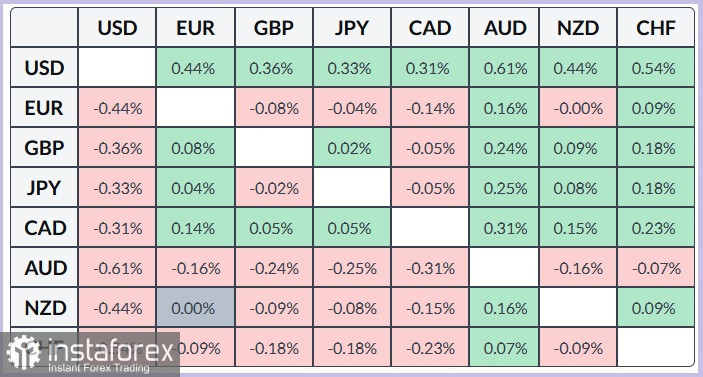
The table below shows the percentage change of the British pound (GBP) against major currencies today. The British pound has shown the greatest strength against the Australian dollar.
From a technical perspective, the short-term trend is moderately bearish, as the pair remains below the significant 100- and 200-day simple moving averages and the round level of 1.3400, indicating a loss of upward momentum after several failures near the 200-day SMA. However, since prices remain above the 20-day SMA and have not fully absorbed Tuesday's upward momentum, bulls still have a chance to fight.
It is worth noting that the oscillators are mixed, and while the Relative Strength Index (RSI) is neutral, it has not yet fully entered positive territory. Therefore, traders looking to buy should exercise caution.


