
Veja também


 03.02.2026 09:24 AM
Although Bitcoin bounced from its yearly low near $79,000 yesterday, that does not indicate traders are ready to buy aggressively. The rebound appears speculative, and it is too soon to declare the bear market over.

Many analysts now forecast the end of the near?term bear cycle only in the first half of 2026. The Bitcoin bottom could appear near $60,000. That scenario rests on several fundamental factors that, in experts' view, will underpin stability and support a later recovery in the crypto market.
First, institutional demand remains resilient despite the market downturn. Bitcoin ETF issuers manage about $165 billion in assets, and corporations continue to buy BTC despite the correction. That points to long?term conviction among large players in the store?of?value case for digital gold, beyond short?term market swings. Institutional investment continues to attract new participants.
Key growth catalysts include the creation of a strategic US Bitcoin reserve, the appointment of a new Fed chair, and rising political support for the crypto industry. Progress on crypto legislation is also important. A US strategic Bitcoin reserve would send a powerful signal of official recognition of the asset's role in the national economy and financial security. A Fed chair sympathetic to cryptocurrencies could ease monetary policy and stimulate capital flows into digital assets. Stronger political backing would create a more favorable regulatory environment for innovation and investment.
It is also notable that the current US administration under President Trump is unlikely to sit idly by while the crypto market declines. The next cycle could prove pivotal for Bitcoin. This assessment underscores authorities' apparent intention to support the sector's development and to leverage its potential to bolster the economy. Traders should monitor these key developments closely in order to seize opportunities when a new Bitcoin bull cycle begins.
Trading recommendations:
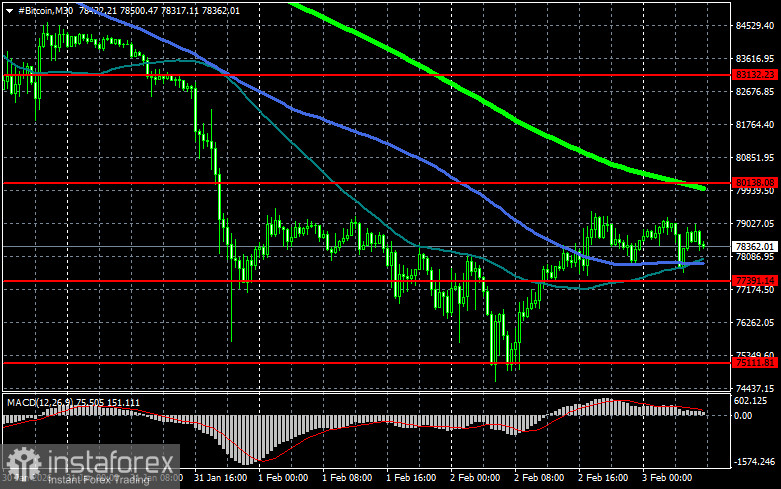
From a technical standpoint, BTC buyers are targeting a return to $80,200, which would open a direct path to $83,100 and then $85,600. The extended target is the peak near $87,900. A breakout of that level would signal attempts to restore the bull market. On the downside, buyers are expected at $77,400. A break below that area could quickly push BTC toward $75,100, with a further downside target near $72,100.
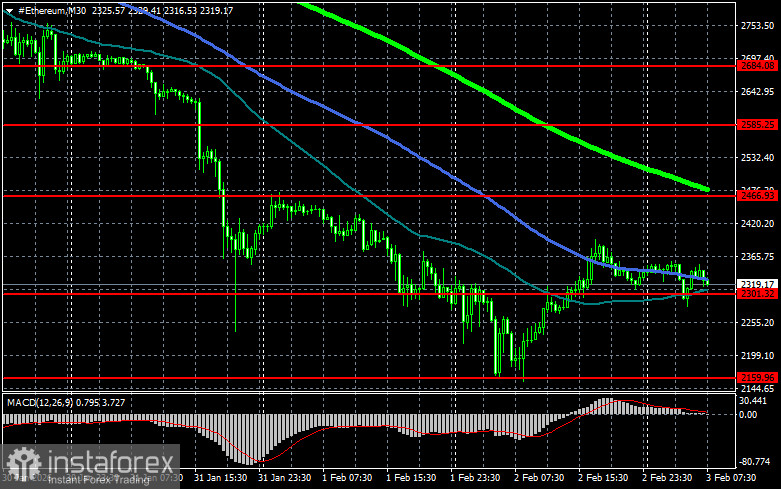
As for Ethereum, a clear consolidation above $2,466 would open a direct route to $2,585. The extended target is the peak near $2,684. Surpassing that level would strengthen bullish sentiment and renew buyer interest. If ETH falls, buyers are anticipated at $2,301. A drop below that zone could rapidly send ETH down to about $2,159, with a farther downside target near $2,017.
What we see on the chart:
- Red lines indicate support and resistance levels where either a price slowdown or active growth is expected;
- Green lines indicate the 50-day moving average;
- Blue lines indicate the 100-day moving average;
- Light green lines indicate the 200-day moving average.
A crossover, or a price test of moving averages, typically either halts the move or sparks fresh market momentum.


