
Vea también


 29.04.2026 12:51 AM
The USD/JPY pair is showing increased volatility amid contradictory outcomes from the Bank of Japan's April meeting. The pair exhibited heightened volatility on Tuesday as it reacted to the outcomes of the Bank of Japan's April meeting. Initially, traders were unsure of the direction of price movement. Immediately after the announcement of the meeting results, the yen strengthened across the market, with the pair hitting a weekly low at 158.97. However, just a few hours later, the Japanese currency came under significant pressure, pushing the USD/JPY pair up by almost 100 pips. Traders adjusted their positions following the press conference by BoJ Governor Kazuo Ueda, who offered less hawkish rhetoric than most market participants expected.
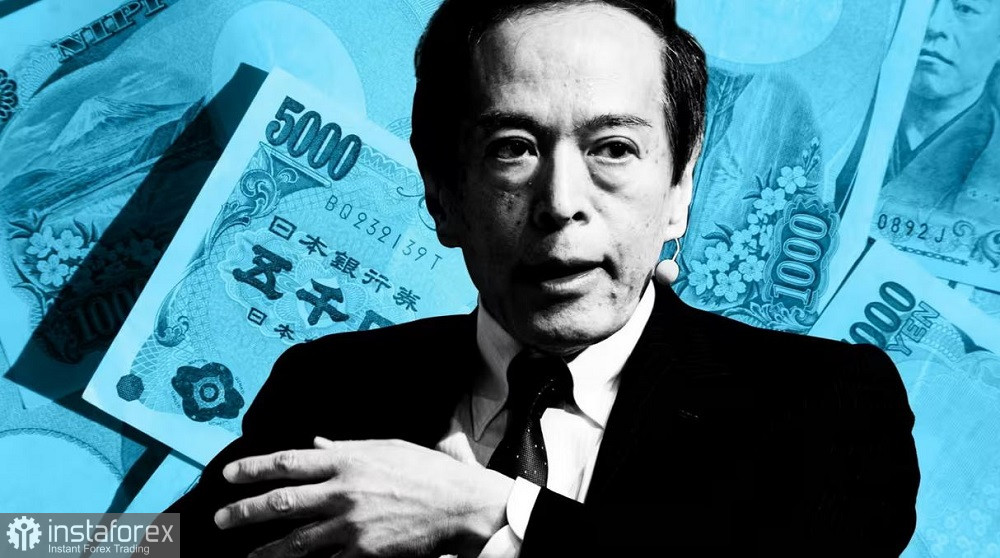
Following the April meeting, the BoJ maintained the short-term interest rate at 0.75%, implementing the basic, most anticipated scenario. However, the vote on the rate demonstrated a significant shift in sentiment within the bank's leadership. Board members Nakagawa, Takata, and Tamura voted for an immediate 25-basis-point rate hike to 1.0%. They argued that the risks of inflation are significantly tilted to the upside and that the target of 2% has been effectively achieved on a sustainable basis.It should be noted that at the previous (March) meeting, the decision to maintain the status quo was also not unanimous. However, only one board member (Hajime Takada) voted for a rate hike then, arguing that preemptive action was needed to avoid an uncontrollable wage-price spiral.
As we see, in April, the "hawkish wing" has added two more members to its ranks. Now, three of the nine members of the Policy Board advocate an immediate tightening of monetary policy parameters. This is no longer a "lonely protest" but an increase in the hawkish camp. The market observed a stable core forming among the bank's leadership, ready for decisive action, and responded accordingly by increasing demand for the yen.
Additionally, the BoJ significantly raised its forecast for core inflation for the current financial year to 2.8%, from the previous (January) value of 1.9%. This decision was also interpreted by the market in a hawkish context; as such, a substantial revision (nearly 1 percentage point) reflects the central bank's concerns about the sustainability of price pressures.
This is why, after the meeting's results were announced and the accompanying statement was published, the yen received short-term support: the unexpected results of the voting on the rate and the revision of inflation forecasts heightened the market's hawkish expectations. Traders began pricing in a rate hike at the next meeting, and the USD/JPY pair hit a weekly low.
However, the "bearish banquet" did not last long. A few hours after the formal results were announced, the press conference by Bank Governor Kazuo Ueda disappointed USD/JPY sellers.
First, Ueda linked the ongoing Middle Eastern conflict (which has entered a prolonged phase) to the prospects for further tightening of monetary policy parameters. According to him, the likelihood of realizing the central bank's base forecast has significantly decreased, primarily due to the escalation of the situation in the Middle East. Market participants interpreted these words as a signal that even with high inflation, the central bank would maintain a wait-and-see position if geopolitics were to hinder the global (and Japanese) economy.
Second, the central bank's head stated directly that he "does not see an immediate need for a rate hike right now." He noted that the bank needs more time to assess how high energy prices will impact domestic consumption in Japan. Such a soft statement contrasted with the positions of the aforementioned dissenters, who demanded an immediate 25-basis-point rate increase. Nevertheless, the fact remains: a stable majority on the Policy Board currently stands with the cautious Ueda.
Additionally, the head of the BoJ commented on the oil market, stating that rising oil prices have a dual effect and are, in essence, a double-edged sword. On the one hand, the rising cost of crude oil pushes inflation higher; on the other, expensive oil acts as a "tax on consumption," reducing real household incomes and corporate profits. Ueda also indicated that a premature rate hike against a backdrop of weak GDP (the 2026 forecast was lowered to 0.5%) could push the economy into recession. Thus, the sharp yen fluctuations are driven by conflicting signals from the BoJ. On the one hand, there is the strengthening of the hawkish wing of the central bank; on the other, there are the cautious comments from Kazuo Ueda.
But can we trust the current rise of USD/JPY? In my opinion, no. Firstly, the head of the Japanese central bank did not announce anything fundamentally new. His words merely contrasted with the strengthening hawkish sentiment within the Policy Board. Secondly, the USD/JPY pair is once again approaching the key resistance level of 160.00 (the upper line of the Bollinger Bands on the daily chart). This is not just a technical level; it serves as a sort of "red line" for Japanese authorities—overcoming this mark could trigger currency intervention or corresponding verbal signals.
Therefore, price spikes in USD/JPY towards the boundaries of the 160 figure should be viewed as an opportunity to open short positions, with an initial target of 159.50 (the middle line of the Bollinger Bands on H4) and a primary target of 159.10 (the lower line of the Bollinger Bands on the D1 timeframe).


