Vea también


 26.06.2026 12:53 AM
On Thursday, as of the writing of this report, the EUR/JPY pair was trading at the round level of 184.00. This almost symbolic rise reflects market indecision caused by simultaneously acting but contradictory trends in monetary policy.
In Europe, the European Central Bank raised the deposit rate by 25 basis points to 2.25% at its June meeting. This decision was made against the backdrop of a weakening economy, driven by geopolitical tensions in the Middle East.
ECB Executive Board member Isabel Schnabel once again adopted a hawkish stance, emphasizing that further rate hikes are necessary to reach the inflation target of 2%, as current levels are still not in the zone that exerts a restraining influence on the economy. She also noted that the relative stability of the European economy justifies the continued tightening of monetary policy, dismissing the idea of a premature pause. This position provides technical support to the euro, limiting selling pressure.
However, the macroeconomic situation in Europe remains ambiguous. The GfK consumer confidence index in Germany for July stood at -29.2, a slight improvement over the upwardly revised June figure of -29.7; however, the result is significantly worse than expectations of -27.5. Weak domestic demand in Germany, the largest economy in the Eurozone, limits the impact of the ECB's hawkish rhetoric and underscores that monetary tightening is occurring amid economic instability.
As for the Japanese yen, it is also supported by institutional factors. The Bank of Japan continues its path toward normalizing monetary policy, as confirmed by the opinion review following the June meeting, during which several board members indicated the need to accelerate the increase of interest rates to a neutral level for the economy. Board member Naoki Tamura reiterated the importance of bringing the key rate closer to the neutral level, which is estimated at around 2%.
Moreover, discussions about a potential coordinated currency intervention by the U.S. and Japan create additional risks for short positions in the yen. Japanese Finance Minister Suzuki Katayana and U.S. Treasury Secretary Scott Bessent confirmed their willingness to take action in the currency market if necessary, strengthening expectations of intervention and providing a temporary boost to the Japanese yen. Japan's Chief Cabinet Secretary Minoru Kihara also hinted at the possibility of considering appropriate measures in response to sharp fluctuations in currency rates. In this context, the yen is being held at certain low levels, which limits the short-term growth potential of the EUR/JPY pair.
From a technical standpoint, the recent drop below the 100-day SMA favors the bears. However, the pair has shown resilience below the round level of 183.00. Additionally, the important 200-day SMA is inclined upwards, indicating a global growth trend. But for the near term, oscillators are negative, confirming the bears' advantage in the market. Therefore, the path of least resistance for spot prices is downward, in the current range from the April high to the May low. Any pullback will meet resistance at the round level of 184.00 and the 100-day SMA. However, if the bulls manage to overcome this level, the next barrier will be the 20-day SMA, after which they will have a chance to advance further.
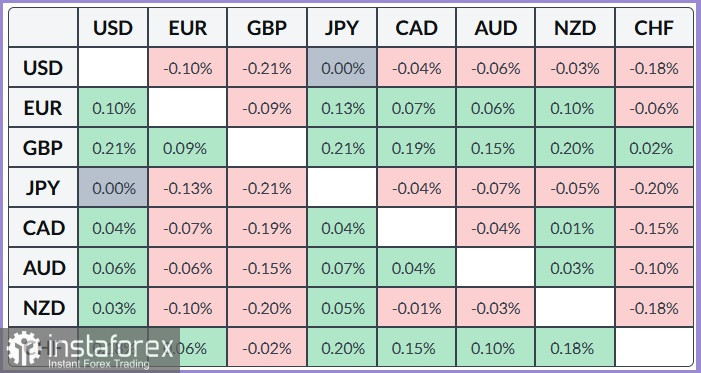
The table below shows the percentage change in the euro exchange rate against major currencies for Thursday. The most significant growth of the euro was recorded against the Japanese yen.