
Vea también


 07.07.2026 05:54 AM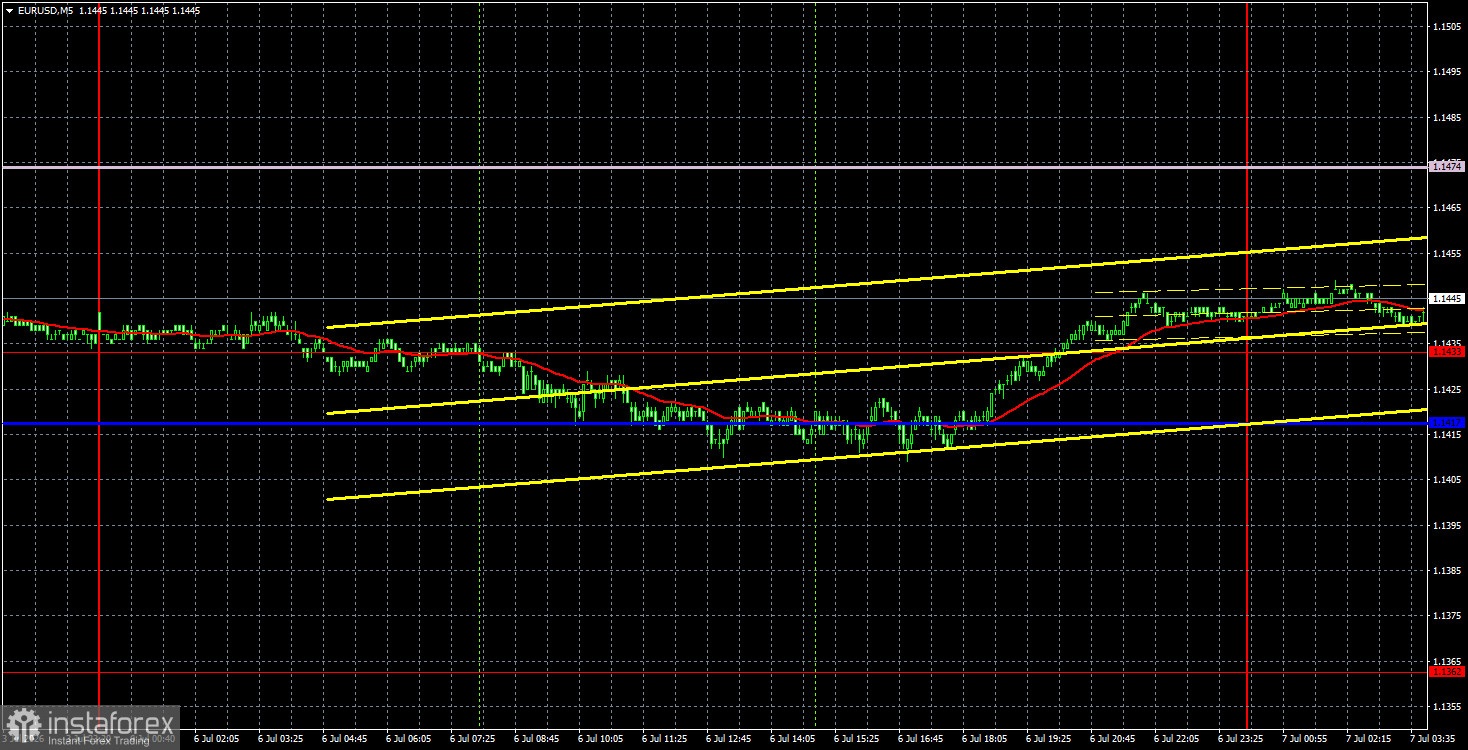
The EUR/USD currency pair demonstrated only microscopic growth and minimal volatility on Monday. This is largely due to the complete absence of significant events on the calendar. Although the ISM Services PMI was an important indicator, it didn't significantly impact the market. The report's value for June fully aligned with expert forecasts, leaving essentially no grounds for a reaction. Business activity in the services sector remains at a fairly high level; however, market attention is still focused on prospects for the Federal Reserve's monetary policy. As the market continues to anticipate several rounds of tightening policy by the end of the year, the euro can currently expect at most a correction. The euro has been in an upward movement for two full weeks and has not even managed to break the Senkou Span B line during this time. Therefore, despite the local uptrend, the long-term trend remains downward.
From a technical standpoint, the upward trend continues, but after ten days of growth, the price still sits below the Senkou Span B line, which speaks volumes about the current strength of the bulls. If the Senkou Span B line is broken, it will provide support to the euro, even if just slightly. A consolidation below the trend line will bring the bears back into the market. However, the technical picture currently appears to be a correction, after which the primary trend will resume.
On the 5-minute timeframe, the price spent nearly the entire day on Monday in the range of 1.1417-1.1433 and only managed to consolidate above it towards the end of the day. Thus, traders could open long positions late in the evening, which can certainly be carried over to Tuesday. The nearest target for the euro is the Senkou Span B line, which is at the level of 1.1474.
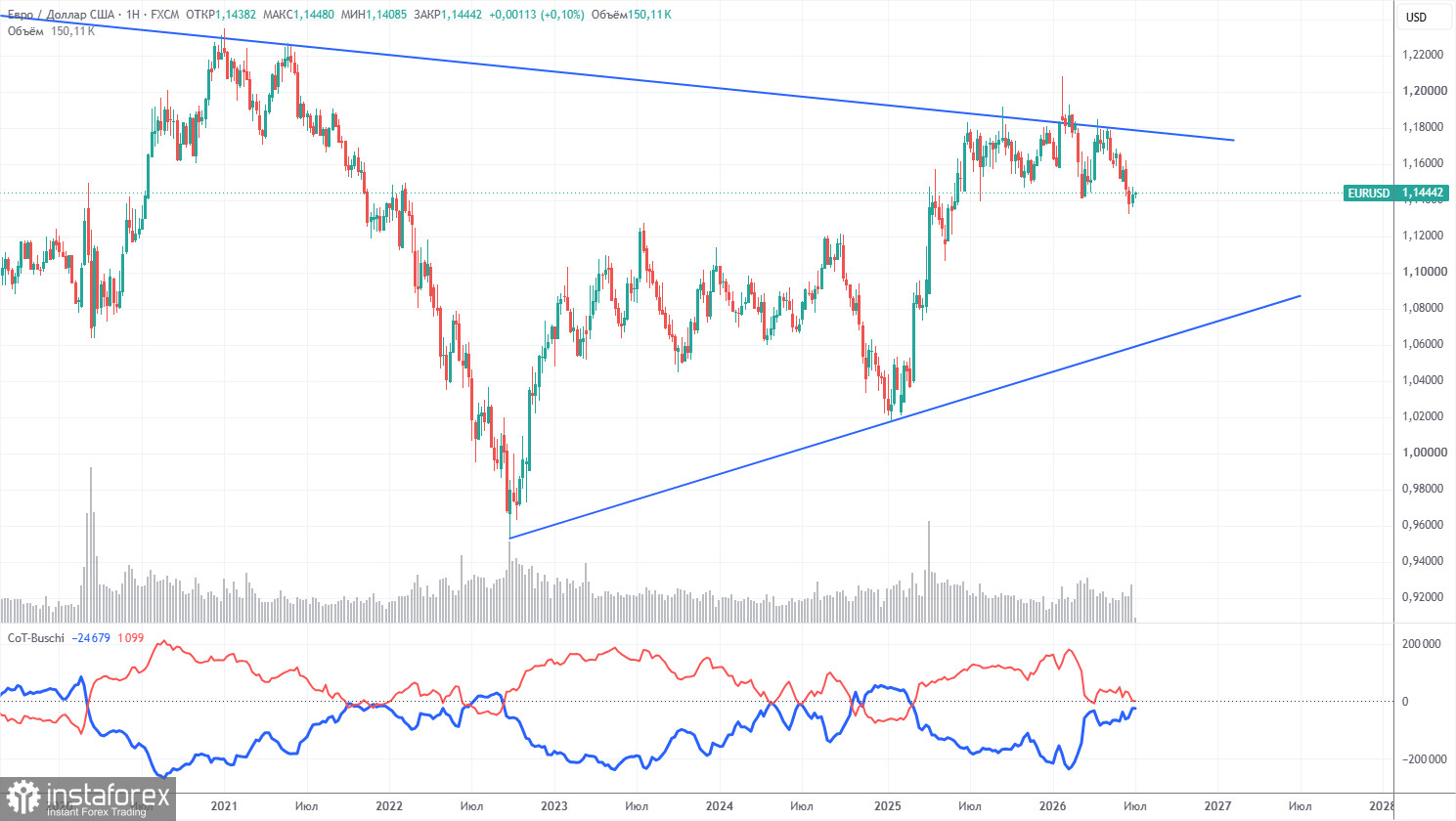
The latest COT report is dated June 30. The weekly timeframe illustration shows that the net position of non-commercial traders remains "bullish" but has significantly decreased due to geopolitical events. Traders have been disposing of the European currency in favor of the U.S. dollar in recent months. Trump's policies have not changed, yet the dollar has served as a "reserve currency" for some time. However, this process may have already run its course.
We still do not see any fundamental factors supporting a strengthening of the euro, while there are adequate factors supporting a decline in the U.S. dollar. The war in the Middle East made the dollar temporarily super-attractive, but once this factor's "shelf life" expires, everything will revert to normal. It may have already expired. In the long term, the euro could drop to around $1.08 (the trend line), but the upward trend will still remain relevant. Over the past months, the rise of the dollar has not brought the pair close to this line.
The positions of the red and blue lines in the indicator indicate parity between bulls and bears. During the last reporting week, the number of long positions in the "Non-commercial" group decreased by 11,700, while the number of shorts increased by 17,400. Consequently, the net position fell by 29,100 contracts over the week.
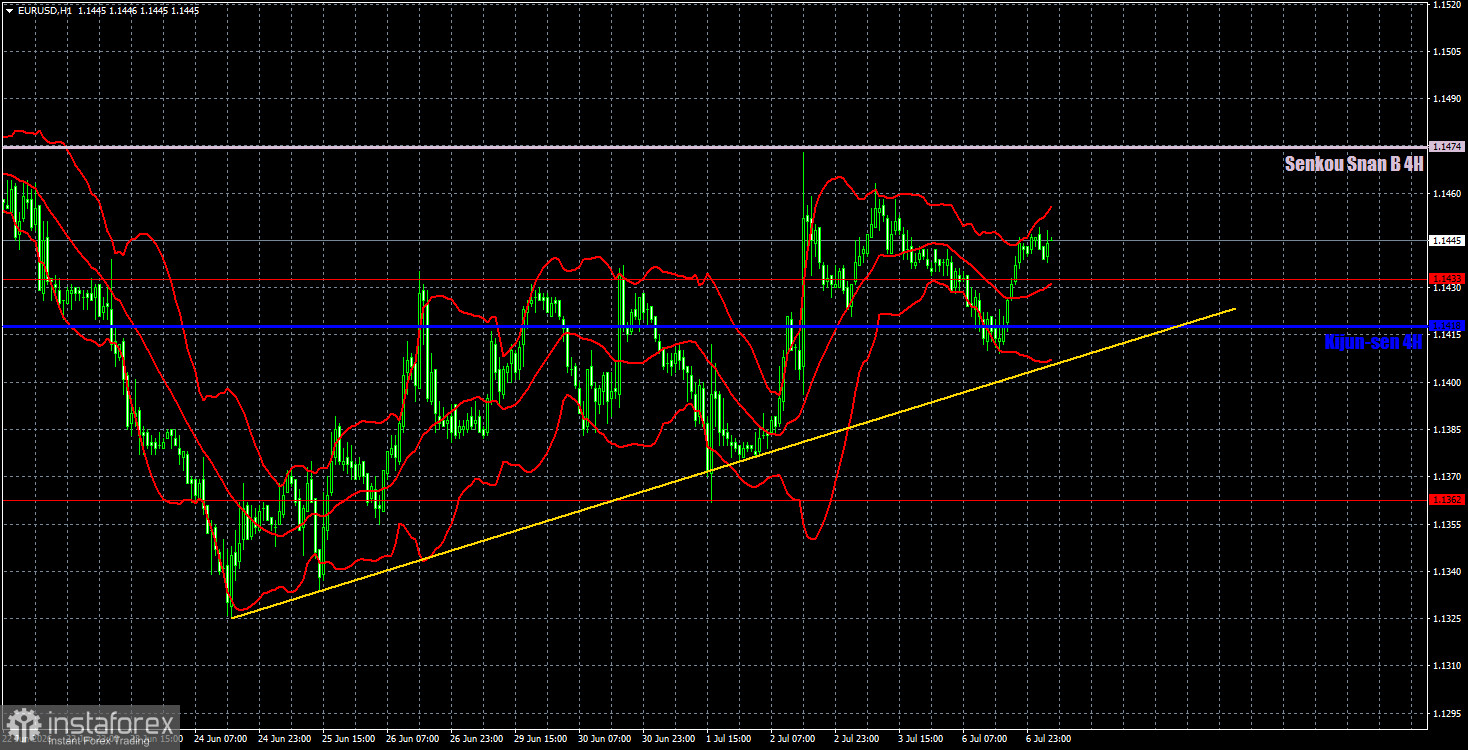
On the hourly timeframe, a corrective upward trend continues to form within a two-month downward trend. The situation in the Middle East remains tense, but we do not consider the ongoing strikes between Iran and the U.S. or the uncertainty in negotiations and deal prospects as sufficient grounds for further strengthening of the dollar. The Fed supported the American currency three weeks ago, but concurrently, the market is ignoring all factors favoring the euro.
For July 7, we highlight the following trading levels: 1.1234, 1.1274, 1.1362, 1.1433, 1.1536-1.1542, 1.1585, 1.1657-1.1666, 1.1750-1.1760, 1.1786, 1.1830-1.1837, as well as the Senkou Span B line (1.1474) and Kijun-sen (1.1418). The Ichimoku indicator lines may shift throughout the day, which should be taken into account when determining trading signals. Remember to set a Stop Loss at breakeven if the price moves in the right direction by 15 pips. This will protect against potential losses if the signal proves false.
On Tuesday, the most interesting event of the day will be Germany's industrial production report, which is not expected to elicit much reaction. Overall, the current week is likely to be very quiet in terms of macroeconomic and fundamental events, so we do not anticipate significant price changes.
Today, traders may consider short positions targeting 1.1362 if the price consolidates below the trend line. Long positions can be supported after a bounce from the area of 1.1417-1.1433 with targets at 1.1474 and 1.1536-1.1542.


