
Vea también


 22.09.2026 12:58 PM
The morning brought a mixed picture: the euro continued to lose ground amid domestic political problems in Germany, while the pound, despite an attempt to renew last week's low, quickly recovered and returned to its usual sideways range. The dollar is generally maintaining the initiative following the Fed's recent decision, but the pressure on the euro and the pound is developing for different reasons today, and these should be analyzed separately.
The main source of pressure on the euro today was not economic data but politics. German Chancellor Friedrich Merz stated that he did not intend to leave office despite the disastrous result of the state elections for his party—the worst result in its history. In Mecklenburg-Western Pomerania, the CDU received only 4.9% of the vote, coming close to failing to clear the 5% threshold for entry into the state parliament, while the far-right Alternative for Germany (AfD) won a decisive victory with 38.2% support. For the currency, such results are significant not in themselves but as a signal of political instability in the region's largest economy: Merz has been chancellor for only 16 months, yet calls for his resignation are already being voiced within his own party. For the euro, this is an additional source of pressure on top of its already weakened position, and the market will likely closely monitor how the internal party conflict develops over the coming days.
The pound is facing a different situation today. The pair managed to renew last week's low, but the sell-off quickly lost momentum, bringing GBP/USD back into the sideways channel. This rapid reaction indicates that the channel boundaries are still viewed by the market as significant reference points, and market participants appear more inclined to buy local declines than to increase pressure on the pound.
Among the U.S. data releases in the second half of the day will be the Richmond Fed Manufacturing Index, but much more important will be speeches by three Fed officials—John Williams, Thomas Barkin, and Philip Jefferson. Following the recent unanimous rate hike and the noticeably more hawkish outlook for the rate path, traders will look in their comments for confirmation or, conversely, moderation of the course that has just been established. This rhetoric, rather than the secondary regional index, will determine the dollar's movement through the end of the session. If even one of the speakers supports further monetary policy tightening, the dollar could easily consolidate yesterday's advantage against a broad range of currencies. For EUR/USD, this means the risk of a further widening divergence with the ECB: although the European central bank also raised rates, it has already characterized the move as part of the process of moving closer to its target, whereas the Fed has just indicated the opposite—that further steps remain quite possible. If U.S. officials today echo Warsh's hawkish tone, this difference in their willingness to continue tightening will become an even more significant source of pressure on the euro. The situation for GBP/USD is no less vulnerable: the pound has already been weakened by the Bank of England's decision to leave rates unchanged, and without strong domestic drivers, the pair risks moving solely in response to what Williams, Barkin, and Jefferson say today.
Momentum
For the euro, the key upward level is 1.1478. A breakout above it could take the pair toward 1.1499 and then 1.1523. This scenario is realistic only if today's Fed speakers deliver clearly dovish signals; without them, a sustained rise will be difficult given the current political environment in Germany. I consider a downside break of 1.1457 to be the more relevant scenario, with targets at 1.1436 and 1.1412, as both Merz's domestic political problems and expectations of hawkish rhetoric from U.S. officials are exerting pressure in the same direction.
For the pound, the upside level is 1.3368, above which the pair could reach 1.3397 and then 1.3420. Given that buyers have already demonstrated their willingness to buy declines today, this scenario remains viable if Fed officials' comments are not excessively hawkish. A downside break of 1.3334, with targets at 1.3304 and 1.3275, remains relevant, but judging by today's rapid recovery, a more significant catalyst than the general dollar backdrop will be required for this scenario to materialize.
Mean Reversion
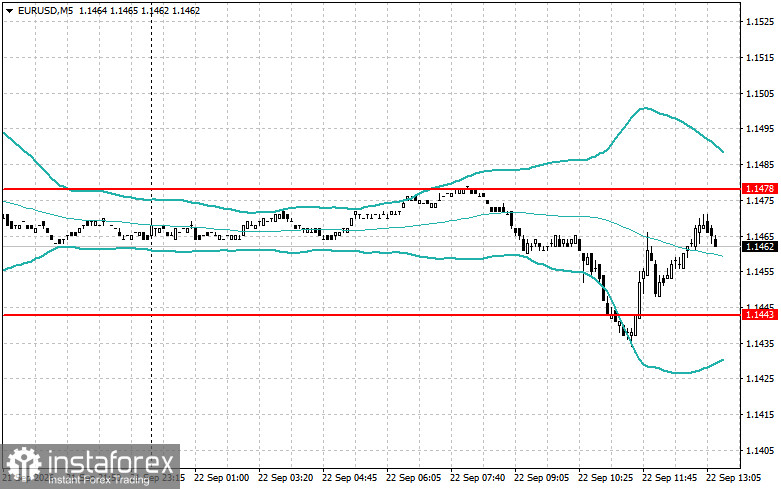
For the euro, I am monitoring the upper boundary at 1.1478. The logic is simple: the pair attempts to hold above this level, but there are not enough buyers to sustain the move, and the price falls back below it—a sell signal. Given the current political pressure on the euro, this scenario appears reasonable. The lower reference level at 1.1443 works according to the opposite logic, but buying here should be approached with caution: uncertainty surrounding Merz's political future continues to weigh on the euro, making a sustained rebound difficult to expect, and it would be reasonable to keep the target for such a trade modest.
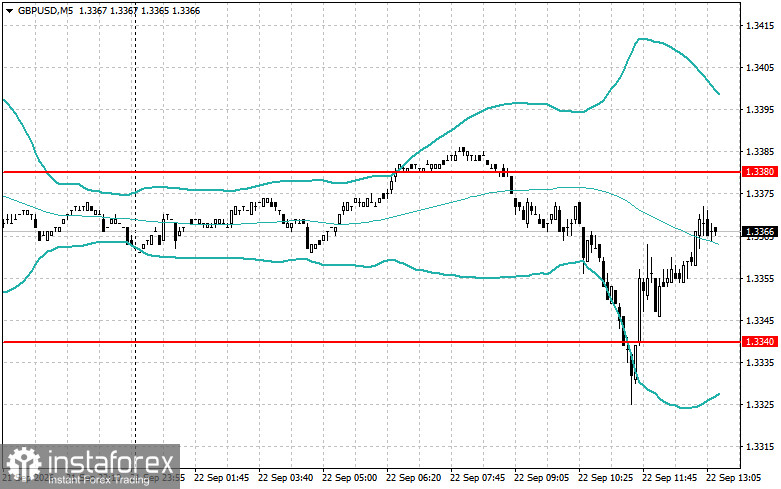
For the pound, the upper boundary is 1.3380. The same return-to-range pattern applies here, and given that the pair has just confirmed the significance of its channel boundaries by quickly recovering from the decline, a false break above the upper boundary followed by a return inside the range appears to be a logical scenario. The lower reference level at 1.3340 suggests buying on a rebound following a false break below the level. Today's price action has already shown that this type of reaction is currently more consistent with market behavior, although the Fed officials' speeches later today could still change the situation.


