
Vea también


 24.09.2026 01:02 PM
Analysis of Trades and Trading Advice for the Euro
The price did not reach any of the levels I had identified during the first half of the day.
The euro reacted with an increase to Germany's Ifo Business Climate Index for September, which rose to 89.9 points from 88.8 in August, continuing its recovery for the fourth consecutive month. The services sector showed a notable improvement, returning to positive territory, while assessments in the retail sector also became somewhat more optimistic. Expectations in the industrial sector increased, particularly in the electrical engineering sector, while the automotive industry, in the institute's own wording, continues to face a difficult period. However, despite the euro's positive reaction to these figures, the pair failed to sustain the upward momentum: the market returned fairly quickly to its previous downward trend. I believe this is not due to the quality of the German data, which were quite encouraging, but rather to the fact that the strength of the dollar, supported by strong US economic data and hawkish Fed rhetoric, is currently simply outweighing any positive surprises from Germany.
The US economic calendar for the second half of the day is relatively light: weekly initial jobless claims are due, with expectations at 201,000, which is notably below the recent range of 203,000–206,000, as well as New Home Sales, which had previously shown signs of cooling to 607,000 on an annualized basis. However, I believe the market's main focus will not be on these figures but on speeches by Thomas Barkin, Beth Hammack, and John Williams. If Williams also aligns himself with his colleagues' more hawkish tone today, this would send a strong signal to the market that the consensus within the Fed has definitively shifted toward further tightening. For the euro, such a development would mean another shift in favor of the dollar, and I do not rule out the possibility that EUR/USD will continue to decline specifically on the back of this rhetoric rather than today's relatively limited economic data.
As for the intraday strategy, I will place greater emphasis on the implementation of Scenarios No. 1 and No. 2.
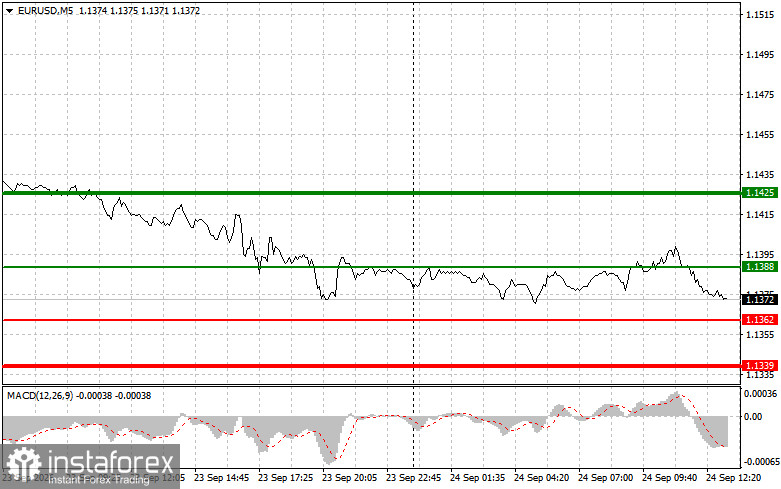
Buy Signal
Scenario No. 1: Today, the euro can be bought when the price reaches around 1.1388 (the green line on the chart), with a target of rising toward 1.1425. At 1.1425, I plan to exit the market and also sell the euro in the opposite direction, targeting a move of 30–35 points from the entry point. The euro can be expected to rise today only as part of a correction. Important! Before buying, make sure that the MACD indicator is above the zero level and is just beginning to rise from it.
Scenario No. 2: I also plan to buy the euro today if the price tests 1.1362 twice consecutively while the MACD indicator is in the oversold zone. This will limit the pair's downward potential and lead to a reversal to the upside. A rise toward the opposite levels of 1.1388 and 1.1425 can be expected.
Sell Signal
Scenario No. 1: I plan to sell the euro after the price reaches 1.1362 (the red line on the chart). The target will be 1.1339, where I plan to exit the market and immediately buy in the opposite direction, targeting a move of 20–25 points in the opposite direction from the level. Downward pressure on the pair may return at any time. Important! Before selling, make sure that the MACD indicator is below the zero level and is just beginning to decline from it.
Scenario No. 2: I also plan to sell the euro today if the price tests 1.1388 twice consecutively while the MACD indicator is in the overbought zone. This will limit the pair's upward potential and lead to a reversal to the downside. A decline toward the opposite levels of 1.1362 and 1.1339 can be expected.
What Is Shown on the Chart:
Important. Beginner Forex traders should exercise extreme caution when making decisions about entering the market. Before the release of important fundamental reports, it is best to stay out of the market to avoid exposure to sharp price fluctuations. If you decide to trade during news releases, always use stop orders to minimize losses. Without stop orders, you can lose your entire deposit very quickly, especially if you do not use money management and trade large volumes.
And remember that successful trading requires a clear trading plan, such as the one presented above. Making spontaneous trading decisions based on the current market situation is inherently a losing strategy for an intraday trader.


