
See also


 12.12.2025 09:21 PM
The wave pattern on the 4-hour chart for EUR/USD has transformed, but overall remains quite clear. There is no talk of canceling the upward trend segment that began in January 2025, but the wave structure since July 1 has become significantly more complex and extended. In my view, the instrument has completed the formation of corrective wave 4, which took a very unconventional form. Inside this wave, we saw exclusively corrective structures, so there was no doubt regarding the corrective nature of the decline.
In my opinion, the formation of the upward trend segment is not complete, and its targets may extend up to the 1.25 level. The a-b-c-d-e wave series appears finished; therefore, in the coming weeks I expect the construction of a new upward wave sequence. We have already seen the presumed waves 1 and 2, and now the instrument is in the process of forming wave 3 or c. I expected that within this wave, the instrument would rise to the level of 1.1717, corresponding to the 38.2% Fibonacci retracement, but this wave is taking on a more extended form—which is very positive, as it increases the likelihood of an impulsive wave. And with it, the entire upward sequence of waves.
The EUR/USD rate remained almost unchanged on Friday, as the market paused after two days of digesting the Fed meeting. In my view, the market's reaction was logical. It could have been different, as the FOMC results—as always—can be interpreted in many ways. Some traders might have noticed "hawkish" hints for 2026, others may have focused solely on the third consecutive rate cut, and some may be looking at the long-term perspective and expect that Donald Trump will eventually prevail and push the Fed to cut the rate to 2% or even lower.
However, in my opinion, the current news background should be assessed as a whole, rather than selectively.
Taken together, we observe the following set of factors:
These three key factors work against the U.S. dollar. The fourth factor is the wave-based factor, as the upward segment of the trend still does not appear complete. The fifth factor includes those developments that have not yet been priced in over the past few months—namely two rounds of the Fed's monetary easing and the U.S. government shutdown. Incidentally, the shutdown may resume on February 1, since Democrats and Republicans have only agreed to fund the government for 2.5 months, and at the moment there is no information about progress in negotiations regarding Democrats' demands to maintain current levels of healthcare and social program funding.
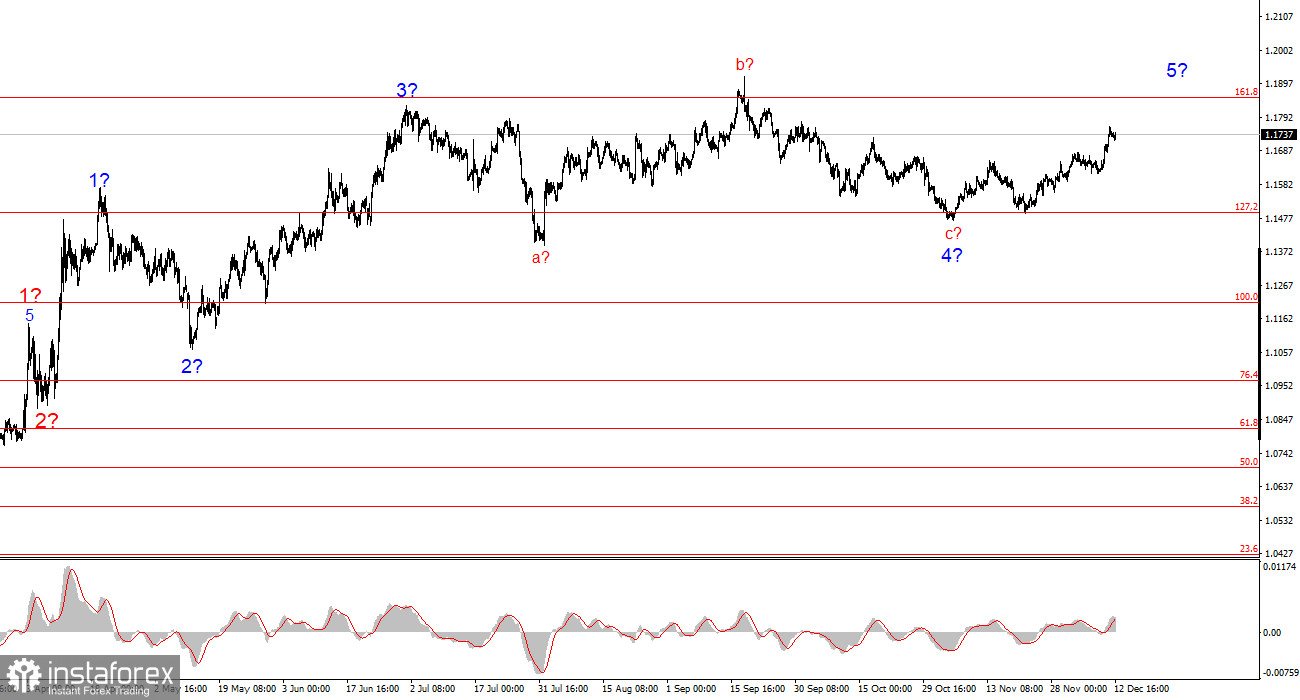
Based on the analysis of EUR/USD, I conclude that the instrument continues forming an upward trend segment. Donald Trump's policies and the Federal Reserve's monetary policy remain significant long-term factors contributing to the decline of the U.S. currency. The targets of the current trend segment may reach the 1.25 level. The latest upward trend segment is beginning to develop, and it is reasonable to believe that we are now observing the formation of an impulsive wave sequence within the larger wave 5. In this case, growth toward the 1.25 level should be expected, as previously mentioned.
On a smaller scale, the entire upward trend segment is clearly visible. The wave pattern is not entirely standard, as the corrective waves vary in size. For example, the larger wave 2 is smaller in size than the internal wave 2 within wave 3. But this also happens. Let me remind you that it is best to isolate the most readable structures on the chart, rather than attempt to label every single wave. At present, the upward structure raises no doubts.
Key Principles of My Analysis


