Lihat juga


 25.06.2026 12:56 AM
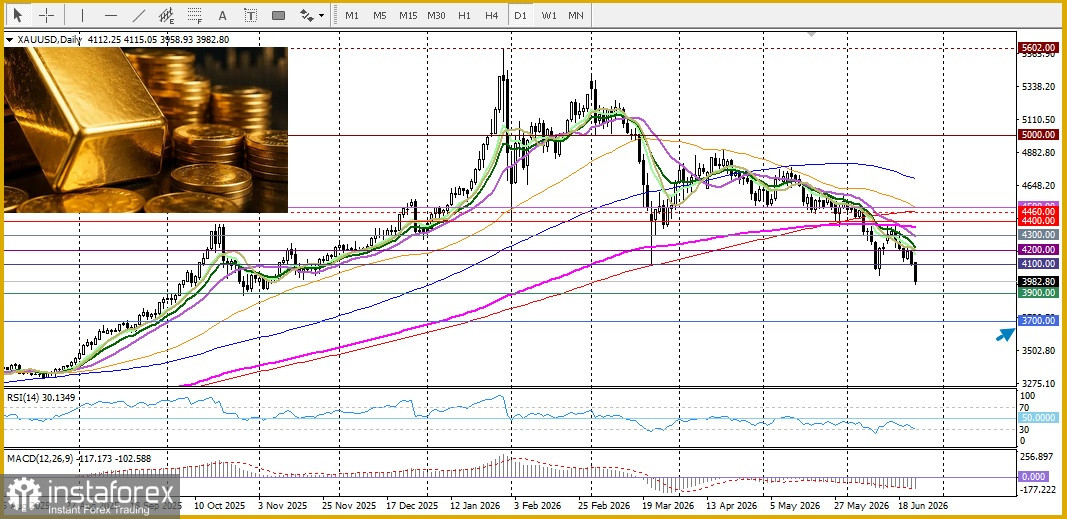
The gold market failed to hold the round support level of $4,000 per ounce. Although this level has drawn significant attention in recent weeks, analysts are confident that the current correction, reflecting a bearish trend, should not be viewed as the end of a long-term bull market.
On Wednesday, positions in the "yellow metal" weakened as the U.S. dollar index reached a high not seen in more than a year. The spot price of gold during trading was recorded at $3,980.20 per ounce, down more than 3% for the day.
The dollar is showing sharp growth as markets begin to actively price in expectations for interest rate hikes. The Federal Reserve is signaling its intent to curb inflationary pressures. According to CME FedWatch data, markets are forecasting a rate hike as early as September, with potential further monetary policy tightening also in December.
However, Paul Williams, managing director of Solomon Global, noted that investors should view current gold price dynamics in a broader context. He explained that a nearly 30% decline in gold prices from January's record highs is not unusual compared with previous bull cycles.
"In the 1970s, gold fell approximately 45% between mid-decade peak values and the lows of 1976 before soaring to record levels in 1980. During the financial crisis of 2008, gold prices dropped around 30%, followed by a strong rise that led to historical highs in 2011," he remarked. "These examples illustrate that sharp corrections are often part of long-term investments in gold, and investors should ask themselves: have the fundamental reasons for owning this asset changed? In my view, the answer is no."
Despite the massive sell-off of gold against the backdrop of rising alternative costs of holding the asset and signals from the Fed about its readiness to raise interest rates, Williams noted that gold prices remain well above last year's levels.
"Even at the current level, gold has appreciated nearly 20% over the past 12 months," he emphasized. "The factors that have supported gold's value in recent years—such as purchases by central banks, geopolitical uncertainty, and high levels of national debt—have not suddenly disappeared. Short-term price fluctuations are often driven by profit-taking, changing expectations regarding interest rates, and fluctuations in currency dynamics, rather than fundamental changes in long-term investment outlooks for gold."
While analysts maintain an optimistic view of gold's long-term prospects, they also caution investors about the possibility of further downward price corrections. Some experts suggest that the price of gold could drop to as low as $3,700 per ounce.