
Lihat juga


 21.10.2026 05:19 PM
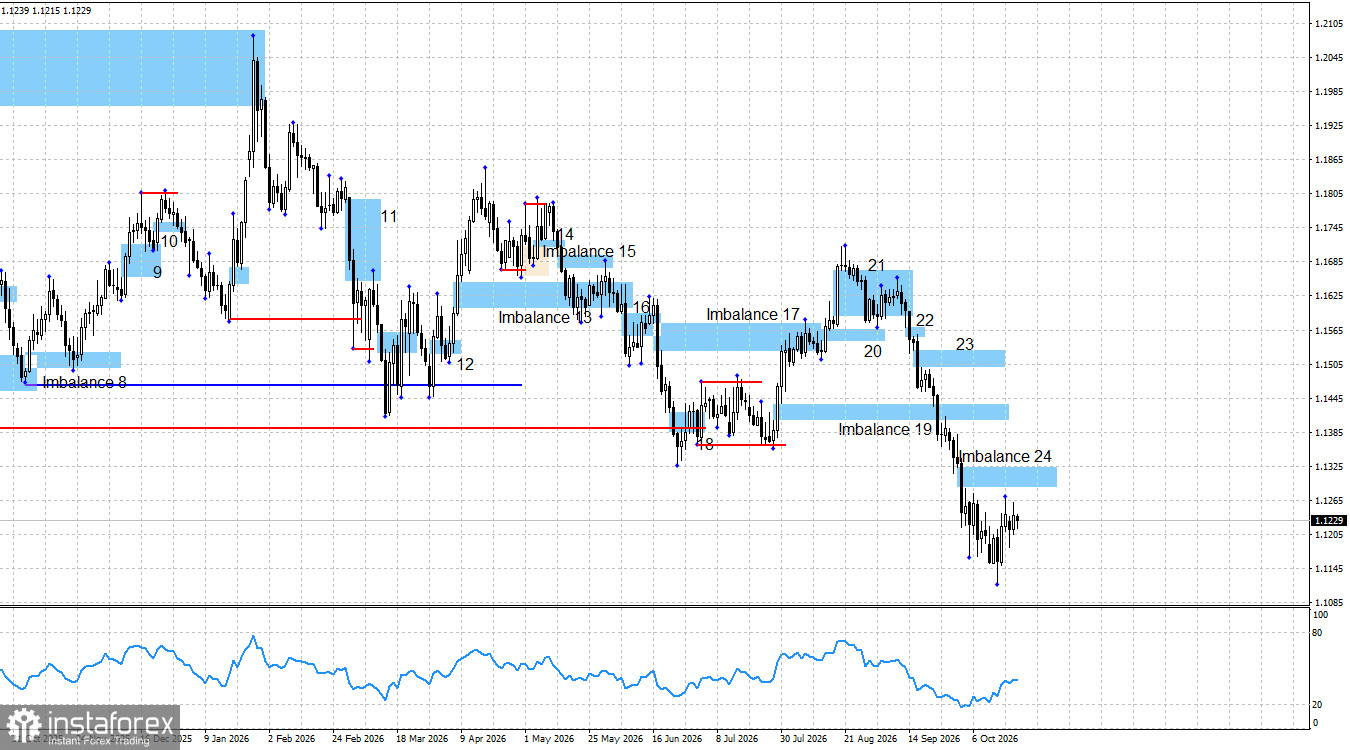
The EUR/USD pair had been declining for 25 full days, apart from a few brief pauses. During this period, the euro lost 530 points, and its downward trend began more than a month ago as the market prepared for an increase in the FOMC policy rate. Only toward the end of last week did the bulls manage to launch a counterattack, which faded almost as quickly as it began. Moreover, the bulls' advances occurred on days when the dollar could easily have continued rising. As a reminder, US inflation in September came in above forecasts, core inflation also exceeded market expectations, and the Producer Price Index showed a much sharper acceleration than the market had anticipated. Since all three inflation indicators are rising more strongly and rapidly than the Fed expects, the dollar could reasonably have strengthened based on a simple relationship: higher inflation increases the likelihood of tighter Federal Reserve policy. Therefore, the bears may simply have become exhausted after their prolonged advance, giving the bulls a brief respite.
However, over the past two weeks, no FOMC member has advocated monetary policy tightening in October. On Friday, Fed President Kevin Warsh spoke but did not forecast or announce further policy tightening either. In other words, Fed policymakers have given the market no indication that higher inflation should lead to a more hawkish policy stance. In my view, the bears have been on the offensive for too long, while the dollar has strengthened too much relative to the scale of rate increases the Fed has planned. Traders have also largely ignored the ECB's rate increases throughout this period. Thus, regardless of how strong the bears may be, they currently lack clear reasons to continue their advance.
At this stage, it is too early to say that the euro's decline has stopped and reversed. Imbalance 24 remains active, and the price could react to it, creating a new sell signal. The bears have pushed too far, and stopping them will now be difficult. Although the market has consistently ignored for more than a month the fundamental factors supporting the euro, this does not mean that the European currency will now rise continuously. First, Imbalance 24 needs to be invalidated, and the bulls need to form their own bullish patterns. This would require a sharp upward move in the euro, but the bulls continue to show weakness and a lack of momentum.
In September, the FOMC not only raised its policy rate but also signaled its willingness to continue tightening monetary policy. This was enough to trigger a broad advance by the bears. However, even after the Fed's policy tightening in September and the possibility of further tightening in December, I do not believe that the euro has lacked positive developments throughout this period.
Overall, in my view, the fundamental backdrop continues to favor the bulls. Although the Fed has adopted a more hawkish monetary policy stance, this is not the only factor determining exchange rates. The European Union also faces problems, but that is precisely the point: problems exist everywhere, yet only the euro is falling. Both central banks are tightening monetary policy, but only the dollar is rising.
The current chart structure points to an unambiguously bearish momentum. Among the relevant patterns, Imbalance 24 remains in play and could be tested in the near future, as a corrective pullback has now begun. The bulls' current opportunity lies in sweeping liquidity below the 1.1066 low. However, more than a simple liquidity sweep is needed to justify opening long positions.
There was no significant economic data on Wednesday, which explains the low level of trading activity. No major changes in EUR/USD are expected before the end of the day. This week, only Friday's news flow offers anything of particular interest to traders.
There are still numerous reasons for the bulls to launch an advance in 2026. Structurally and fundamentally, Trump's policies, which caused the dollar to decline significantly last year, have not changed. At present, there are no major factors providing support for the US currency, despite the FOMC's hawkish stance. Geopolitical developments, which supported demand for the dollar during much of the first half of 2026, are no longer doing so.
On October 22, the economic calendar contains just one release, which traders are unlikely to pay much attention to. Economic data are unlikely to influence market sentiment on Thursday.
In my view, the pair remains in the process of forming a bullish trend that has been undergoing a corrective pause for an entire year. The fundamental backdrop shifted sharply in favor of the bears eight months ago, but the trend itself, which has been in place for four years, cannot be considered invalidated or complete.
The bulls may resume their advance before the end of the year, but their only realistic opportunity at present is the 1.1066 low established in June last year. The bears received a new sell signal within Imbalance 19. At this stage, existing short positions should remain open. A new sell signal may form within Imbalance 24. Since a further corrective pullback remains possible, it would be prudent to take partial profits on short positions.


