
Veja também


 01.07.2026 06:12 PM
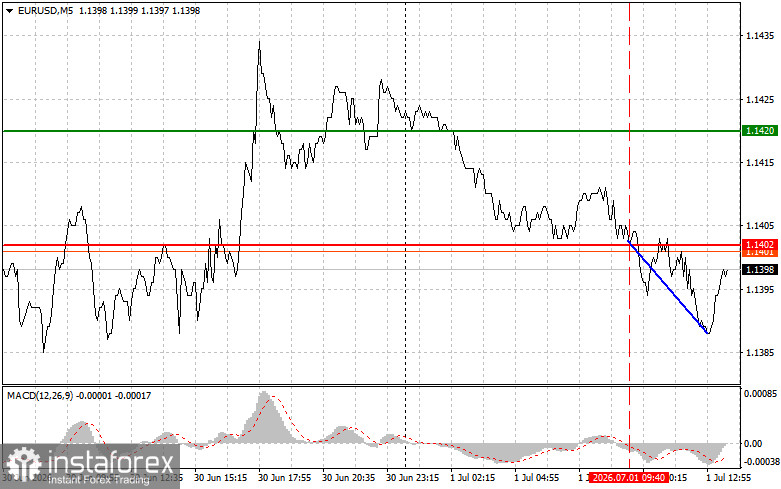
The test of the 1.1402 level occurred when the MACD indicator had just begun moving below the zero line, confirming a valid entry point for a short position on the euro. As a result, the pair declined by 15 points.
The euro weakened following the release of the latest macroeconomic data. Market expectations for higher inflation were not met, as the Consumer Price Index (CPI) showed a significant slowdown. Inflation eased to 2.8% year-over-year, compared with the expected 3.0%, signaling to market participants that the European Central Bank (ECB) may adjust its monetary policy, which weighed on the euro.
Attention now turns to another round of U.S. labor market data. The June ADP Employment Change report and the ISM Manufacturing PMI will be released, while FOMC Chairman Kevin Warsh is also scheduled to deliver a speech. These macroeconomic indicators play a key role in shaping the Federal Reserve's future monetary policy. The ADP report, published ahead of the official employment data, will provide an early indication of labor market conditions in the private sector. Strong figures could reinforce confidence in the resilience of the U.S. economy, while weaker-than-expected results may increase concerns about an economic slowdown.
The ISM Manufacturing PMI will provide an assessment of conditions in the manufacturing sector, one of the key drivers of the economy. However, the primary focus will be on the speech by FOMC Chairman Kevin Warsh. Investors and analysts will closely examine his comments on the current state of the economy, inflation expectations, and the outlook for interest rates.
As for my intraday strategy, I will primarily rely on the implementation of Scenario No. 1 and Scenario No. 2.
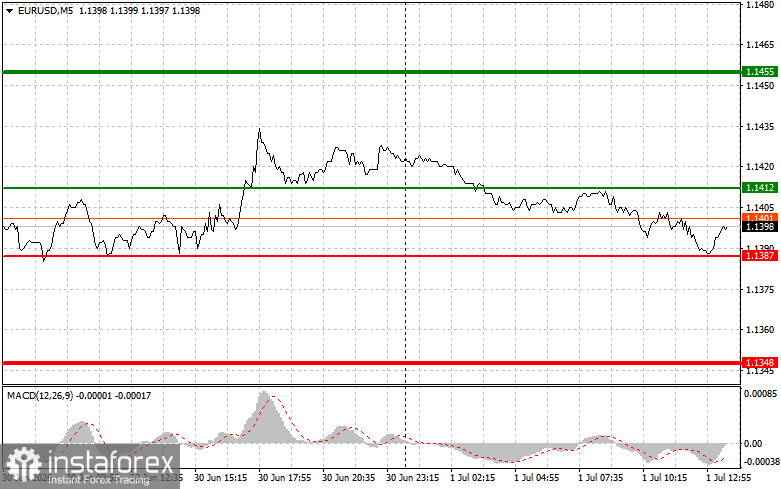
Scenario No. 1: Consider buying the euro if the price reaches 1.1412 (the green line on the chart), with a target at 1.1455. I plan to exit long positions at 1.1455 and simultaneously consider opening short positions, expecting a 30–35 point pullback from that level. The euro is likely to strengthen today if the U.S. data disappoint. Important: Before buying, make sure the MACD indicator is above the zero line and has just begun moving higher.
Scenario No. 2: I also plan to buy the euro if the price tests 1.1387 twice consecutively while the MACD indicator is in oversold territory. This would limit the pair's downward potential and trigger a bullish market reversal. In this case, the pair may rise toward 1.1412 and 1.1455.
Scenario No. 1: I plan to sell the euro after the price reaches 1.1387 (the red line on the chart). The target will be 1.1348, where I intend to exit short positions and immediately consider opening long positions, expecting a 20–25 point rebound from that level. Selling pressure is likely to return if U.S. economic data exceed expectations. Important: Before selling, make sure the MACD indicator is below the zero line and has just begun moving lower.
Scenario No. 2: I also plan to sell the euro if the price tests 1.1412 twice consecutively while the MACD indicator is in overbought territory. This would limit the pair's upward potential and trigger a bearish market reversal. In this case, the pair may decline toward 1.1387 and 1.1348.
Important: Beginner Forex traders should exercise caution when entering the market. It is generally advisable to stay out of the market ahead of major fundamental data releases to avoid sharp price fluctuations. If you choose to trade during news releases, always use stop-loss orders to minimize potential losses. Trading without stop-loss orders can quickly result in the loss of your entire trading account, particularly if you trade large position sizes without applying proper risk management.
Finally, remember that successful trading requires a clear trading plan, such as the one outlined above. Making spontaneous trading decisions based solely on current market conditions is generally a losing strategy for intraday traders.


