
Lihat juga


 21.10.2026 01:37 PM
Analysis of Trades and Trading Tips for the Japanese Yen
The price test at 158.11 in the first half of the day occurred just as the MACD indicator was beginning to move downward from the zero line, confirming that it was an appropriate entry point for selling the US dollar. However, the pair did not experience a significant decline.
USD/JPY enters the second half of the day without support from US economic data, and no comments from Federal Reserve officials are expected either, as the central bank typically enters a blackout period ahead of a policy meeting. As a result, the Middle East remains the main market driver.
A separate issue concerns Japan itself. According to Tsutomu Watanabe, a former Bank of Japan official and professor emeritus of economics at the University of Tokyo, Japan has gained approximately 195 trillion yen, or $1.2 trillion, in additional fiscal space because inflation reduces the real value of government debt. In his report, the economist noted that this benefit could help Prime Minister Sanae Takaichi finance her defense and investment plans.
The economist explained that the government benefits from the lag between rising market interest rates and the effective interest rates on its outstanding debt of 1,100 trillion yen. The resulting windfall is known as the debtor's gain and currently exceeds 180 trillion yen. However, this is unlikely to help the Japanese yen strengthen against the US dollar in real exchange rate terms.
As for the intraday strategy, the focus will be on implementing Scenarios #1 and #2.
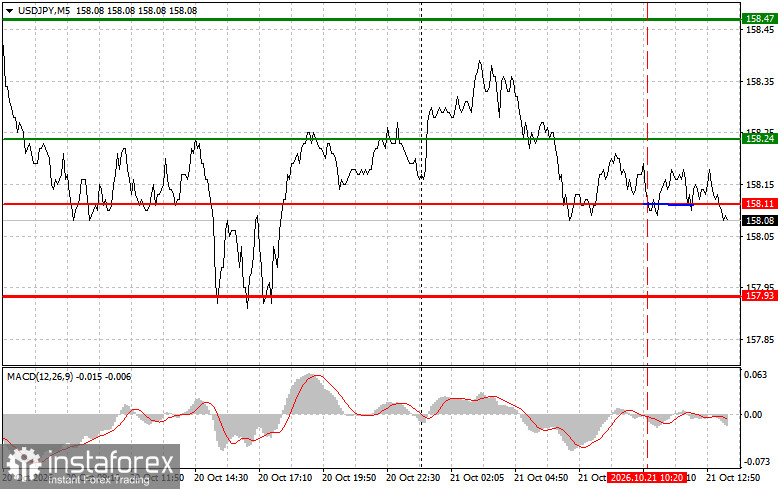
Scenario #1: The plan is to buy USD/JPY today when the price reaches the entry level around 158.19 (the green line on the chart), targeting a rise to 158.47 (the thicker green line on the chart). Near 158.47, the long position will be closed and a short position opened, targeting a move of 30–35 points in the opposite direction from that level. The pair may rise today, although the upward potential appears limited. Important: Before buying, make sure that the MACD indicator is above the zero line and has only just begun to rise from it.
Scenario #2: USD/JPY can also be bought today if the price tests 158.04 twice consecutively while the MACD indicator is in the oversold zone. This would limit the pair's downward potential and trigger a reversal to the upside. The pair could then rise toward the opposite levels of 158.19 and 158.47.
Scenario #1: The plan is to sell USD/JPY today after the price breaks below 158.04 (the red line on the chart), which could trigger a rapid decline in the pair. The key target for sellers will be 157.78, where the short position will be closed and a long position opened immediately, targeting a rebound of 20–25 points from that level. Selling pressure on the pair could return if the authorities intervene in the currency market. Important: Before selling, make sure that the MACD indicator is below the zero line and has only just begun to decline from it.
Scenario #2: USD/JPY can also be sold today if the price tests 158.19 twice consecutively while the MACD indicator is in the overbought zone. This would limit the pair's upward potential and trigger a reversal to the downside. The pair could then decline toward the opposite levels of 158.04 and 157.78.
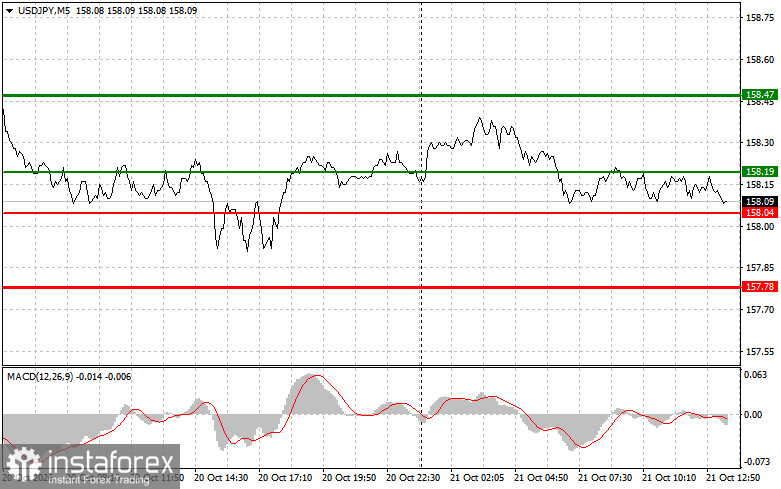
Important. Beginner Forex traders should exercise great caution when making entry decisions. Before the release of major fundamental reports, it is best to stay out of the market to avoid exposure to sharp exchange rate fluctuations. If trading during news releases, always place stop-loss orders to minimize losses. Without stop-loss orders, the entire trading account can be depleted very quickly, especially when risk management rules are not followed and positions are opened with large volumes.
Remember that successful trading requires a clear trading plan, such as the example presented above. Making spontaneous trading decisions based on current market conditions is a fundamentally losing strategy for an intraday trader.


