
یہ بھی دیکھیں


 20.03.2026 12:58 AM
On Thursday, gold (XAU/USD) significantly decreased, losing over 4.5% amid rising US Treasury yields. Market pressures stemmed from investors' concerns about rising energy prices and strong US labor market data, prompting participants to reassess the likelihood of a Fed rate cut to 2027.
The sharp drop in precious metal prices followed the release of macroeconomic data that reinforced expectations for a stricter monetary policy. The resilience of the US economy and signs of inflationary pressures from rising energy costs contributed to higher bond yields and diminished interest in gold as a safe-haven asset.
This week, major central banks worldwide, including the Bank of England, the European Central Bank, the Bank of Japan, and the Federal Reserve, kept interest rates unchanged. Meanwhile, the ECB, according to Bloomberg, is considering further policy tightening. These central bank decisions reflect a response to the escalation of the conflict between the US and Israel against Iran, which has intensified geopolitical and energy instability.
The Fed left the federal funds rate in the range of 3.50%-3.75%, citing persistent inflation and a robust labor market. The vote was 11 to 1, with only Stephen Miran voting for a 25-basis-point cut. According to the updated "Summary of Economic Projections" (SEP), the Fed expects one rate cut in 2026 and another in 2027. Additionally, GDP growth in the US is forecasted to accelerate to 2.4% (up from 2.3% in December), while the core inflation rate is projected to rise from 2.5% to 2.7%, with the unemployment rate remaining at 4.4%.
Recent data from the US Department of Labor showed that initial claims for unemployment benefits for the week ending March 14 decreased from 213,000 to 205,000, contrary to expectations for an increase to 215,000. Following the release of the data, the yield on 10-year bonds rose by almost three basis points to 4.289%. Despite this, the dollar index (DXY) fell.
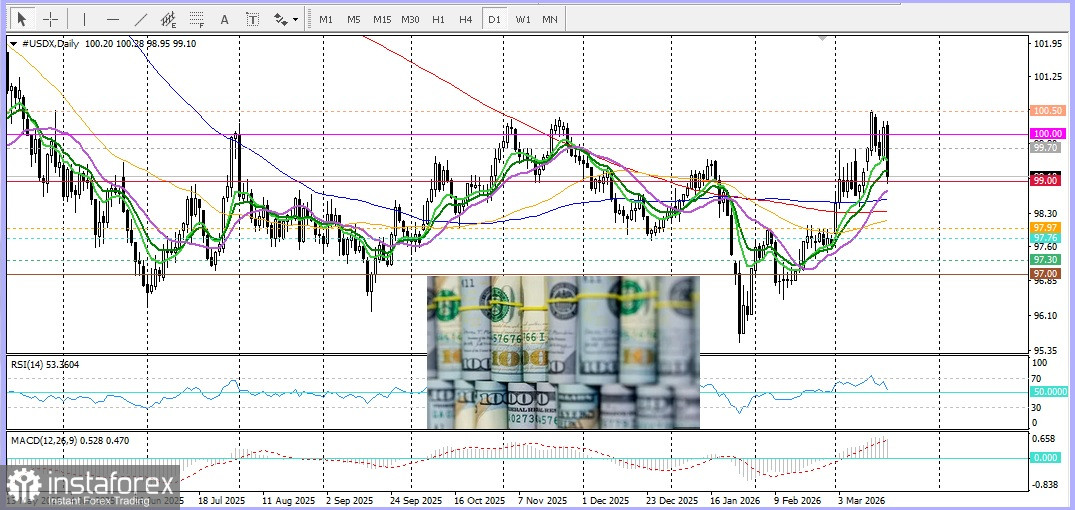
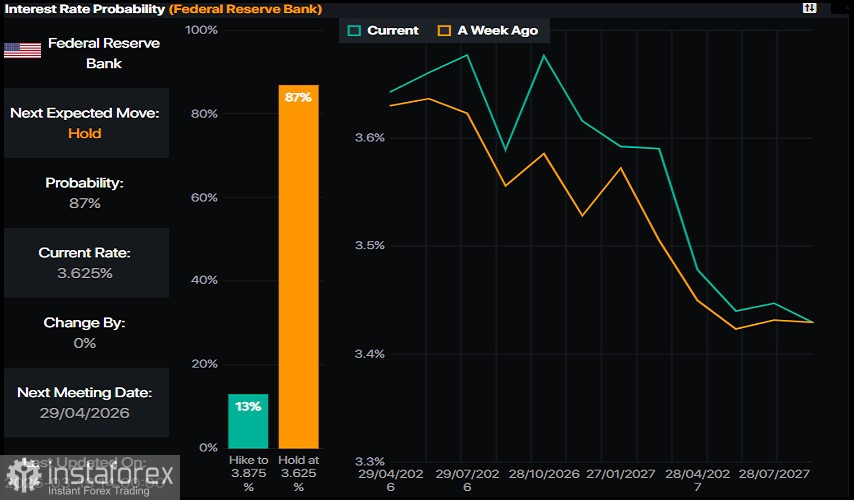
According to Prime Market Terminal data, money markets are not pricing in a Fed rate cut in 2026, expecting the first adjustment only in the first half of 2027.
The escalation of geopolitical tensions has also stimulated capital inflows into traditional safe-haven currencies, specifically the Japanese yen and the Swiss franc. The situation surrounding the energy sector worsened following Iran's attack on Qatar's gas infrastructure. According to the head of QatarEnergy, two of the 14 LNG production lines were damaged, as was one of the 2 GTL fuel production facilities. He noted that this situation could lead to the declaration of force majeure on long-term contracts for LNG supplies to Italy, Belgium, South Korea, and China.
From a technical perspective, the global picture for gold remains bullish; however, the 100-day simple moving average (SMA) at $4590 serves as key support. A breach of this level, along with the round figure of $4500, could open the way for deeper declines toward $4200.
At the same time, if gold manages to overcome $4650, the next resistance will be the low of February 17, now acting as a barrier at $4840.
Oscillators are negative, supporting the bears.


