
Vea también


 13.07.2026 10:09 AM
Meanwhile, as Bitcoin is once again losing ground amid an escalation of the Middle East conflict, the balance of power among institutional clients aligns with a mixed picture that has developed over recent weeks: inflows into Bitcoin ETFs have alternated with outflows, and price recoveries have been met with caution from analysts such as CryptoQuant, who called the rebound a recovery from a dip rather than a full reversal.

Bitwise's latest report documents a clear split of clients into two camps. The first group — which began accumulating Bitcoin several years ago — views the current correction as an opportunity to add long positions, following the same logic shown by long-term holders who keep a record 16 million coins and rarely move them to exchanges. The second group has taken a wait-and-see stance, postponing market entry until greater regulatory clarity emerges, notably the passage of the CLARITY Act — a bill whose fate remains uncertain due to disputes over developer protections and a recent precedent in which Trump blocked a housing bill.
More important than the raw statistics on the client split is the qualitative shift in the questions being asked, which Bitwise highlights. In prior bear markets, institutional investors used to ask whether cryptocurrency would survive at all as an asset class — an existential question that put Bitcoin's legitimacy as an investment tool in doubt. According to the firm, that question has all but disappeared across client segments, replaced by the purely tactical "when and how much to buy." That is a fundamental difference between the current cycle and previous sell-offs, including those in 2018 and 2022 — years that CryptoQuant has noted historically show positive seasonality for Bitcoin in July during bear markets.
Bitwise's observation should be seen as confirmation of a broader institutionalization trend across the industry, reflected in recent actions by a variety of traditional financial players: Charles Schwab launching Bitcoin and Ethereum trading; eight crypto firms being added to the Russell 3000; money-market funds supporting stablecoin reserves from Fidelity, State Street and Invesco; and SWIFT developing blockchain infrastructure for cross-border payments. The disappearance of the survival question does not, by itself, mean the current bear cycle is over or that the structural risks flagged by JPMorgan regarding the rise of private banking blockchains have vanished.
Trading recommendations
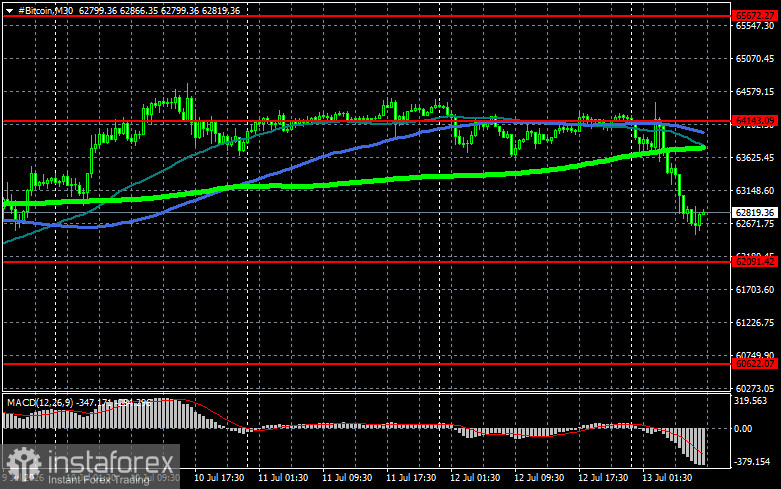
Bitcoin
Buyers are currently targeting a return to $64,100, which would open a direct path to $65,600 and then to $67,700 — a break above the latter would signal attempts to revive the bull market. On the downside, I expect buyers at $62,000. A move back below that area could quickly push BTC toward $60,600. The furthest downside target would be around $58,700.
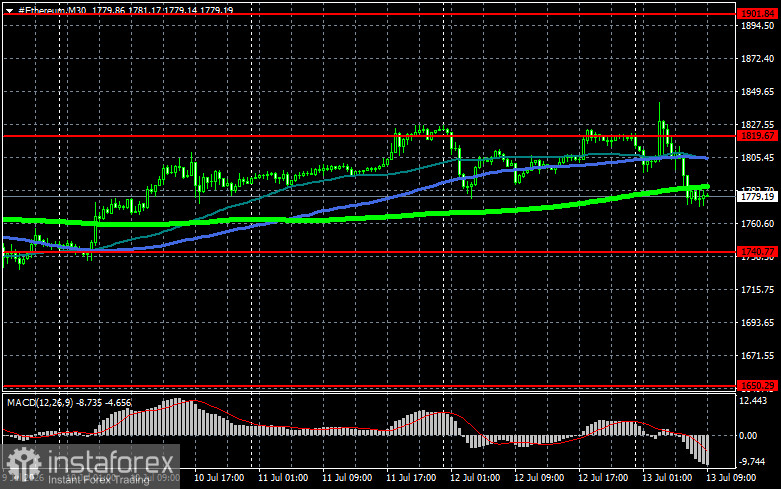
Ethereum
A clear hold above $1,819 opens a direct path to $1,901. The farther target is the high near $1,963; breaking above that would indicate strengthening bullish sentiment and renewed buyer interest. On the downside, I expect buyers at $1,740. A drop back below that area could quickly push ETH toward $1,650. The furthest downside target would be around $1,573.
What's on the chart
Price testing or crossing any of these moving averages often either halts movement or injects fresh momentum into the market.


